Fewer Routine Trips, More Purposeful Travel
The obituary for business travel has been written many times since hybrid work arrived. The numbers disagree. GBTA projects $1.71 trillion in global business travel spending and 1.84 billion trips in 2026 – though the spending figure deserves a caveat: rising prices inflate it, so don’t read it as equivalent growth in trip volume.
The real change is quieter. Companies are more selective about when employees travel, while face-to-face meetings, events and client relationships keep generating demand. A deal that once closed over three routine visits now closes over one deliberate trip – often anchored by a long client dinner, which is precisely the kind of spending that keeps restaurant space near business districts and hotels in demand. Purposeful travel still fills tables; it just fills fewer of them, more deliberately. Volume and value have decoupled. The routine trip is fading; the purposeful trip, and the commercial real estate that serves it, is not.
The New Business Traveler
From Routine Travel to Purpose-Driven Trips
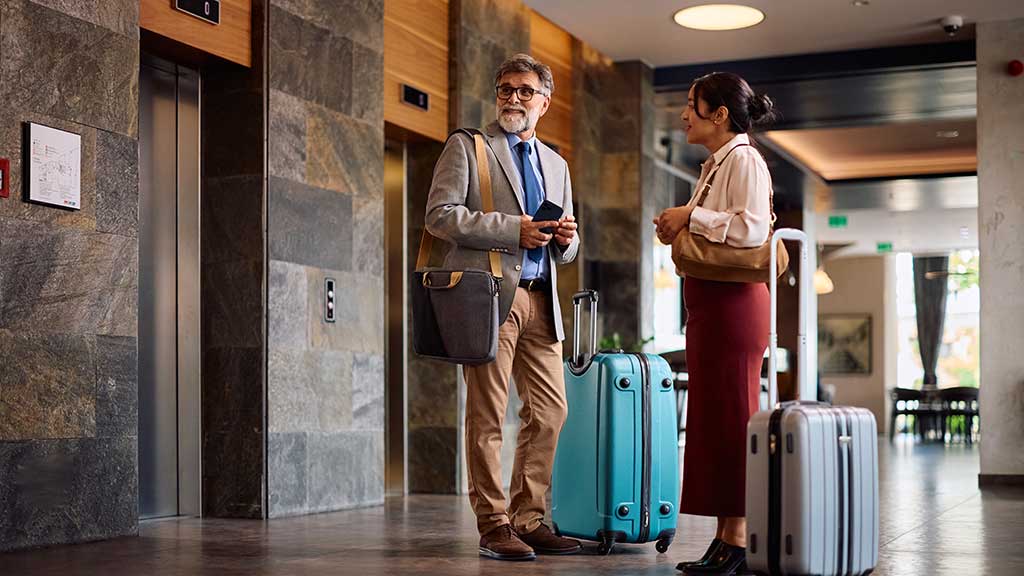
Hybrid work changed the reason for traveling rather than the need for it. The weekly commute to a regional office is largely gone; what’s replaced it is the deliberate trip – a remote team gathering in person for three days, a specialist flying to a client site for a project phase, a department converging for training that video calls handle badly.
Business Travel Becomes More Selective
GBTA reports companies increasingly focused on productivity, visibility, flexibility and the value of individual journeys. When every trip needs a justification, the accommodation choice inherits that scrutiny. Location, reliability and total trip cost matter more when nobody is traveling out of habit. The hotel room is no longer a default – it’s a line item with a purpose attached.
Why Hotels Still Matter to Business Travelers
Convenience for Short and High-Frequency Trips
Take the standard one- or two-night trip. The traveler lands at 8 p.m., presents at 9 a.m., flies home after lunch. What that trip needs is predictability: a central location, housekeeping, breakfast at 6:30, a desk that works. An apartment’s extra space is irrelevant when the traveler barely sees the room. Hotels remain engineered for exactly this pattern, and it still describes a huge share of business travel.
Hotels as Business Infrastructure
Hotels also serve needs beyond sleep – meeting rooms, conference facilities, restaurants, coworking areas, event spaces. Current European hotel research indicates corporate travel is expected to strengthen as business events and international meetings grow beyond pre-pandemic levels. The hotel isn’t just where the business traveler stays; increasingly, it’s where the business happens.
Why Serviced Accommodation Is Gaining Ground
Designed for Longer Stays
The calculation shifts when nights become weeks. A serviced apartment offers what hotels structurally can’t: a kitchen, laundry, separate living and sleeping areas, room to exist rather than just sleep. Nobody wants to eat restaurant meals twenty nights in a row.
Supporting Relocations and Project Teams
The realistic scenario: a project team of four spends six weeks in another city. They need space to work, cook, decompress – the practical requirements of temporary life, not a two-night trip. Relocations, training programs, extended assignments: serviced accommodation fits them all.
Longer Stays Change the Economics of Accommodation
With longer stays, priorities reorder – space, self-catering and laundry over daily housekeeping and a lobby bar. This isn’t a claim that apartments are always cheaper; they aren’t. The point is total value and suitability. European serviced-apartment research identifies longer stays and demand for flexible accommodation as structural trends, not passing ones.
Bleisure and Blended Trips Are Reshaping Demand
When Business and Leisure Overlap
The pattern is now familiar: an employee attends a three-day conference and stays through the weekend. Suddenly the accommodation serves two purposes at once. That changes what matters – neighborhood character, room size, amenities worth lingering for. The trip was booked for business; the memory will be leisure.
Location Becomes More Important
A purely business-district location serves the meeting but not the Saturday. Blended travelers balance proximity to offices against restaurants, attractions and transport. CBRE identifies blended travel and extended stays as trends benefiting lifestyle-oriented hotels that serve corporate and leisure demand simultaneously. The best-located property now answers to two calendars.
What Modern Business Travelers Expect From Accommodation
Reliable Connectivity and Workspace
Accommodation increasingly needs to support work, not just host sleep. Reliable Wi-Fi, a real desk, charging points, quiet areas, access to business facilities – these are baseline expectations now, and travelers notice immediately when they’re missing.
Flexibility and Convenience
The operational layer: flexible booking and cancellation, late check-in that actually works, transport access, practical amenities like irons that exist. Boring details, until one fails at midnight.
Wellbeing Becomes Part of the Experience
Companies and travelers increasingly weigh rest and recovery when choosing accommodation. Sleep quality, quieter rooms, fitness facilities, decent food, a location that doesn’t add an hour of commuting – the connection to productivity is common sense rather than medical claim. A rested traveler presents better. Everyone knows this; travel policies are finally catching up.
Companies Are Balancing Cost With Traveler Experience
Rising Travel Costs Change Accommodation Decisions
Costs are tightening the frame. GBTA forecasts global hotel ADR rising 3.7% in 2026 to $168, with business travel prices under continued pressure from energy and labor costs. Travel managers are being asked to find savings that don’t create friction elsewhere.
The Cheapest Night Is Not Always the Lowest-Cost Trip
The classic false economy: a hotel €40 cheaper per night, forty minutes from the client’s office. Add daily taxis, lost time, the dinner options of a business park – the saving evaporates by Tuesday. Total trip cost includes transport, meals, time and productivity. The nightly rate is just the most visible number, not the truest one.
How These Trends Are Changing Hospitality Demand
Demand Is Becoming More Segmented
Different trips now map to different formats: short meeting → hotel; conference → hotel or lifestyle hotel; two-week project → serviced apartment or extended-stay property; relocation → serviced apartment; business plus leisure → flexible hotel or apartment. One traveler, five patterns.
Location and Product Matter More
Properties combining accessibility, flexibility and appropriate amenities are better positioned for this fragmented demand. The question hospitality operators face is no longer “business or leisure guest?” but “which trip, this week?”
How to Choose the Right Accommodation for a Business Trip
Match the Property to the Trip
The framework runs in order: purpose → duration → location → workspace → amenities → total cost. A two-night negotiation and a six-week implementation are both “business travel” and share almost nothing else. The property type itself is part of the decision too – the hospitality spectrum runs from full-service hotels to motels, hostels and extended-stay properties, and each format serves a different kind of trip.
Think Beyond the Nightly Rate
The useful comparison stacks transport, breakfast, workspace, laundry, food costs, flexibility and travel time beside the room rate. The cheapest-looking option frequently isn’t.
The Future of Business Travel Accommodation
Hotels and Serviced Accommodation Are Moving Closer Together
The future isn’t a contest between hotels and apartments – it’s convergence. Hotels are adding kitchens and longer-stay rates; serviced apartments are adding hotel-grade service. Neither format is disappearing. Both are adapting to travelers whose needs stopped fitting either box neatly.
Conclusion: Business Travel Is Creating More Varied Accommodation Demand
The Right Stay Depends on the Reason for the Trip
Business travel is becoming more selective, more blended, more varied – and accommodation demand is following it. The modern business traveler is no longer defined by the one-night hotel stay. The accommodation choice now reflects the purpose, duration and structure of the journey. Which is another way of saying: the trip decides the room, not the other way around.