A driver who doesn’t show. Surge pricing at five in the morning. A stranger circling the terminal while your check-in deadline runs down. For the business traveller, a reliable airport transfer is not a luxury. It is risk management.
Book ahead — and get the price in writing
The biggest difference between a calm departure and a stressful one is booking in advance at a fixed fare. Metered taxis and app-based surge pricing share the same flaw: you only discover the final cost when you arrive. A pre-booked transfer is agreed before you travel — which also keeps the expense claim refreshingly simple. As a benchmark, Bedford has become a popular base for London-bound commuters, and from there a pre-booked saloon car to Heathrow costs £78 fixed, while Luton, the closest airport, is just £36. Those are door-to-door prices, agreed upfront, whatever the traffic on the M1 decides to do.
Local knowledge beats a big app
National platforms will happily sell you a ride, but the driver who turns up may be navigating your town for the first time. Local firms live on their patch. They know which terminal approach jams at seven in the morning, which station entrance is actually open, and the back route when the motorway is standing still. Operators such as City Cars Bedford build their whole service around exactly this — including flight monitoring as standard, so if your return flight lands forty minutes late, the driver simply adjusts the pickup instead of disappearing. It is the sort of detail you never notice when it works, and never forget when it doesn’t.
Communication is the real product
Ask frequent flyers what went wrong on a bad transfer and it is rarely the car. It is the silence. No driver’s name, no registration number, no idea where to stand in arrivals. The better firms confirm every booking by text or WhatsApp, send the driver’s details before pickup, and stay contactable throughout the journey. It sounds basic, yet it is the first thing cut by the cheapest quotes — and the first thing you miss when a delayed flight leaves you standing outside a terminal at midnight, phone battery fading, with a meeting at nine.
The hidden cost of getting it wrong
It is worth doing the maths on what a failed transfer actually costs. A missed flight means rebooking fees, a lost working day, and occasionally a lost client. Set against that, the difference between the cheapest quote and a dependable one is usually the price of a coffee. Experienced travellers treat the transfer the way they treat travel insurance: not the place to save money, but the thing that protects everything else on the itinerary.
Business travel is not always a solo affair. When a team is heading to a conference, a client visit or a flight out of a regional airport, the logistics multiply: several pickups, luggage for six, and one delayed colleague who can unravel the whole plan. This is where a single, larger vehicle quietly earns its keep. A 6 to 8-seater minibus keeps everyone together, on one booking and one fixed fare, instead of scattering the group across three separate cars and hoping they all arrive at the same time. It is also, per head, usually the cheapest way to travel.
When the whole team is travelling
Read the small print before you compare prices
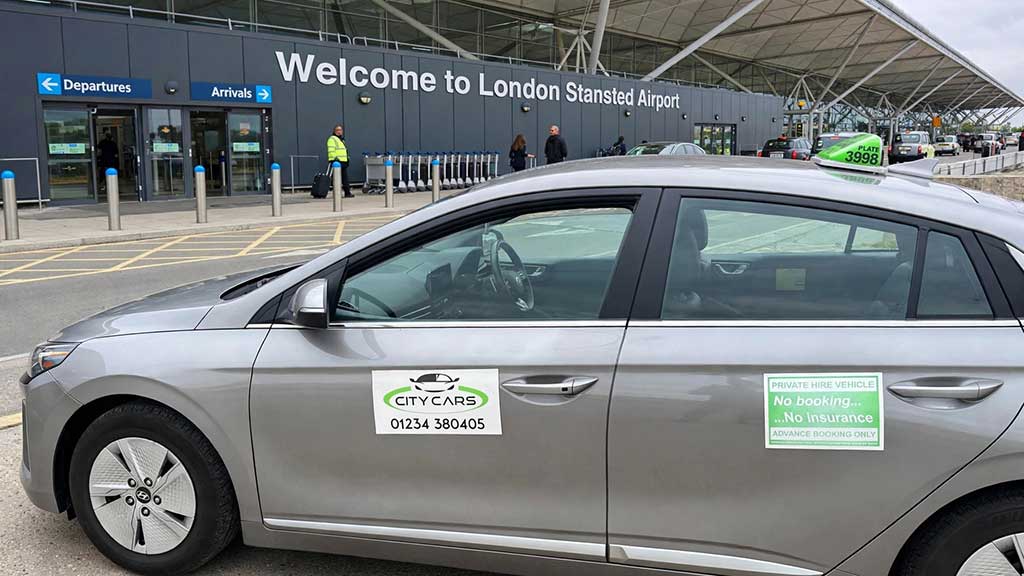
Headline fares are not always the full story. Some quotes quietly exclude the airport’s own drop-off and pickup charges, which then surface on the final bill. Transparent operators state the position upfront. City Cars, for example, publishes its fixed fares — £76 for its Bedford to Stansted airport taxi service and £105 for Bedford to Birmingham airport taxi transfers — and states clearly that airport drop-off and pickup charges are not included, so travellers know exactly where they stand before they book. When you compare quotes, compare what is actually included: waiting time, flight monitoring, a meet-and-greet in arrivals, and those airport charges.
Think beyond Heathrow and Gatwick
Business travellers are increasingly routing through Stansted, Birmingham and London City for better schedules, shorter queues and keener fares — especially from the Midlands and the East of England. A door-to-door transfer is what makes those airports genuinely practical. There is no long-stay car park quietly doubling the cost of a two-day trip, no dragging a suitcase between shuttle buses, and no driving yourself home after a red-eye. The car is simply there when you land.
A simple checklist for your next trip
- Book at least 24 hours ahead, at a fixed fare agreed in writing.
- Choose an operator that monitors your flight and adjusts pickup times automatically.
- Get the driver’s name, vehicle details and a direct phone number before you travel.
- Confirm what the fare includes — and what it doesn’t.
- Save the number of a firm you trust. A good local operator soon becomes part of your travel routine.
None of this is glamorous, and that is rather the point. The best airport transfer is the one you never have to think about — booked in minutes, priced in advance, and quietly waiting when you walk out of arrivals. Get that part right, and every business trip starts the way it should: calm, on time, and focused on the work ahead.