What we liked
- Extraordinary history and architecture, with restored marble staircases and grand public spaces
- A superb spa and a 20-metre pool, rare in central London
- An outstanding choice of places to eat and drink, including a Michelin-starred restaurant
- Butler service and attentive, unobtrusive staff
- An unbeatable Whitehall location, a short walk from Parliament, Trafalgar Square and St James's Park
What we didn't
- The area around Whitehall is busy with tourists
- Small niggle no USB-C charging points
It stands on Whitehall, the most ceremonial thoroughfare in the capital, and from the moment you pass beneath its cupolas you sense that this is no ordinary address. For the business traveller who wants to be at the very heart of London, and to feel something of its history while doing so, there is simply nowhere else quite like it.
A building that witnessed history
The OWO takes its name from the Old War Office. The imposing Edwardian Baroque building, now Grade II listed, was constructed in 1906 to serve as Great Britain’s War Office, and it was from here that Winston Churchill directed the eventual Allied victory in the Second World War. Clad in pale Portland stone, it was the stage for some of the most dramatic decisions of the twentieth century. Remarkably, the ground beneath it carries still older memories, because the Palace of Whitehall once stood on this very site.
The roll call of those who passed through its doors is extraordinary. Churchill, Lord Kitchener and Ian Fleming, the naval intelligence officer who went on to create James Bond, all walked its halls. Lord Haldane reshaped the British Army from his office here, and John Profumo later occupied the same rooms as Secretary of State for War. Perhaps the most enchanting story concerns the end of the war itself. On 8 May 1945, Churchill is said to have made two telephone calls from the building: the first to tell King George VI that the war was over, and the second to order 40 cases of Pol Roger from Berry Bros & Rudd.
Spies, codebreakers and secret doors
This was also a home of British intelligence. MI5 and MI6 both ran operations from these corridors, and the spies were said to have had their own entrance. During the Second World War, candidates for the Special Operations Executive were interviewed and briefed in the basement, and key agents behind Operation Mincemeat worked here. That audacious 1943 deception, which helped divert enemy forces away from Sicily, was partly conceived in the building’s former Naval Intelligence offices.
Look closely as you walk the corridors and the building reveals its working past. Beneath your feet, the corridor carpets take their design from the building’s original floor grilles, which hide the old telephone and telegraph wires, a quiet reminder of the vast communications network that kept the War Office connected to the world. The corridors stretch some four kilometres in total and keep their unusually generous width, which once allowed couriers on bicycles to deliver messages. Even the floors hold secrets: retiring officers were allowed to choose two of the small black and white hallway tiles to be made into cufflinks.
At the heart of it all is the grand staircase, its steps of veined Piastraccia marble rising between alabaster balusters to the balcony where Churchill addressed his staff. Look down as you climb and you notice the risers are unusually shallow. The guides will tell you this was deliberate, so that officers in spurs, and those returning from the front with prosthetic limbs, could manage the ascent with dignity. Two carved lion heads guard the base, and Churchill would rub the nose of the lion on the right for luck after his morning briefings. Guests still do the same, and the stone shows it.
A restoration of rare ambition
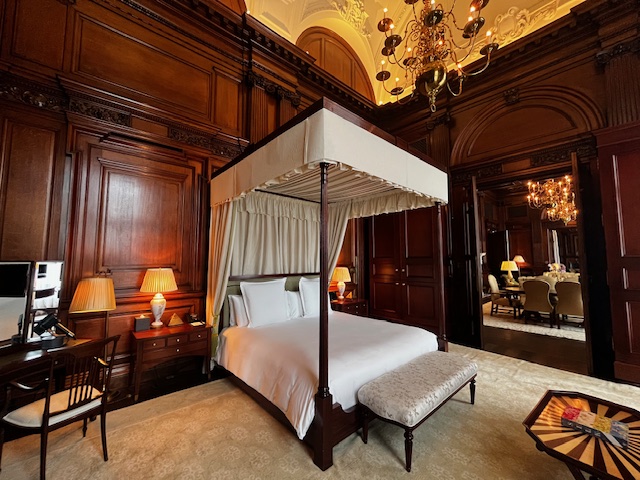
Bringing this building back to life was a monumental task. The £1.4 billion restoration ran for more than half a decade, and hundreds of craftspeople worked to uncover what decades of government modification had hidden, among it the original oak panelling, the hand laid mosaic floors and the marble fireplaces, many of which had been stripped out over the years and have now been returned to the rooms they came from.
Interiors are the work of the late Thierry Despont, and they carry a distinctly statesmanlike air. A rich crimson runs through the scheme, inspired by the coats of the Horse Guards, and the button details on the curtains echo those of the cavalry uniforms. Wood panelling, marble and glittering chandeliers complete a picture of old-world elegance that never feels stuffy.
The Household Cavalry are never far away. Step out of the front door and they are directly opposite, mounted and perfectly still. The connection runs deep, and the hotel tells a charming tale of the troopers stopping by once a week for coffee, with apples set aside for their horses, a small ritual that makes this grand address feel wonderfully human.
The suites
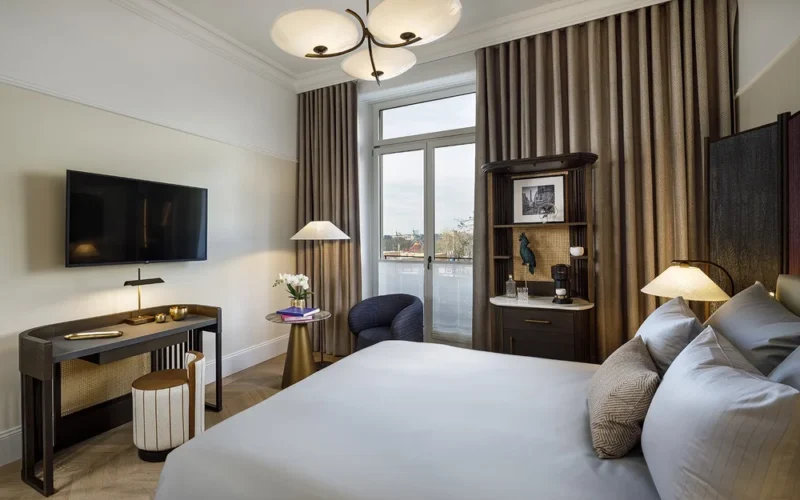
There are 81 rooms and 39 suites, set across five floors. The jewels are the Heritage Suites, created in the former offices of influential political and military leaders, alongside eight Corner Suites named after notable women and female spies, set within the cupolas overlooking Whitehall. The Haldane Suite, once the office of Churchill, Profumo and Haldane, can be combined with neighbouring rooms to form the Whitehall Wing, a six bedroom suite for up to 12 guests, among the largest in London. The Churchill Suite occupies what was once the Council Room, with a grand desk, an ancient fireplace, original oak panelling and 1930s wallpaper.
The doors are worth a second glance too. They are extraordinarily thick, and they open outwards rather than in, a detail that speaks of a building designed for conversations nobody else was meant to hear.
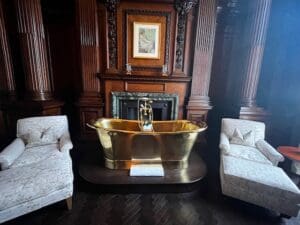
For sheer romance, the Granville Suite is hard to surpass. It honours Christine Granville, the Polish aristocrat and SOE agent said to have been Churchill’s favourite spy. Its bathroom, with a gleaming copper bathtub, has to be one of the most beautiful bathrooms we have come across. The Nearne Suite is equally captivating, with a vaulted bedroom, a skylight and three curved windows from which you can watch the changing of the Horse Guards.
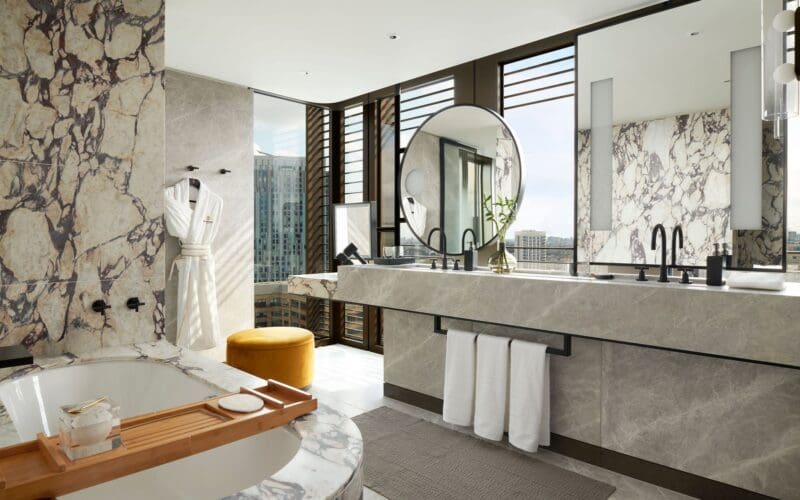
Bathrooms throughout are an indulgence in themselves. Expect marble, underfloor heating for chilly London mornings, a soaking tub and a double vanity. The toiletries are something special too. London perfumer Azzi Glasser created a signature fragrance for the hotel, with notes of Sicilian bergamot, neroli and clary sage over vetiver, cedarwood and black oud. Minibars are stocked with canned Singapore Slings and an espresso machine. Suites come with butler service, a Raffles hallmark.
Dining, drinking and the Spy Bar
The OWO is home to nine restaurants and three bars. Mauro Colagreco, whose Mirazur holds three Michelin stars, oversees Saison, where Mediterranean dishes are served beneath the restored historic glass ceiling. On the rooftop, Kioku by Endo offers outstanding views over Whitehall, Big Ben and the London Eye, and in the central courtyard, Café Lapérouse occupies a jewellery box pavilion beneath a mirrored roof. Across that grand courtyard lie the private residences. Langosteria brings a touch of Milan, and the Drawing Room is the setting for a spy themed afternoon tea.
No Raffles would be complete without its famous cocktail. The Singapore Sling was created in 1915 by Raffles bartender Ngiam Tong Boon, and in the Guards Bar you can order the original alongside the London Sling, made with Raffles’ own gin. For something rarer, the bar pours Louis XIII Cognac by the glass from a Mathusalem.
Then there is the Spy Bar. This late night subterranean speakeasy sits in rooms once used by the Secret Intelligence Bureau, and you enter through the original MI5 vault doors. The building has appeared in the Bond films Octopussy, Licence to Kill and Spectre, and half an Aston Martin DB5, the carbon fibre body of a stunt car from No Time to Die, now hangs above the bar. Photography is forbidden inside, and the bar is open to residents, hotel guests and by invitation, which only adds to the thrill.
For the business traveller
The OWO works beautifully for business. Event spaces include the Whitehall Ballroom, The Lawrence, the Morse and Code Rooms and the Poppy Suite. Downing Street is a five minute walk away. After a long day, the Guerlain Spa and Pillar Wellbeing centre spread across four levels and some 2,500 square metres, with a 20-metre swimming pool, a vitality pool and a gym. Do make time for the history tour, which brings every corner of this remarkable building to life.
Raffles London at The OWO is more than a hotel. It is a chance to sleep within the story of Britain itself, and to leave feeling that you have been let in on its secrets.
How we review
Travelling for Business pays for the rooms, flights and products we review unless we explicitly say otherwise. We never accept paid reviews or gifted stays in exchange for coverage.