

There are places where history is carefully curated behind glass, and then there is Diriyah, the City of Earth, where the past still breathes in the open air.
Walking through its sun-warmed mudbrick alleys, I felt that rare sensation of stepping into a story that is both ancient and urgently contemporary. Few destinations manage to hold memory and momentum in the same moment. Diriyah does — and witnessing it firsthand is extraordinary.
Set along the fertile banks of Wadi Hanifah, Diriyah’s origins stretch back to 1446, when Prince Mani’ bin Rabiah Al-Muraidi established a settlement that would grow into a centre of trade, scholarship and governance. The choice of location, shaded palms, flowing water and the natural protection of the valley, shaped the future of the Arabian Peninsula.
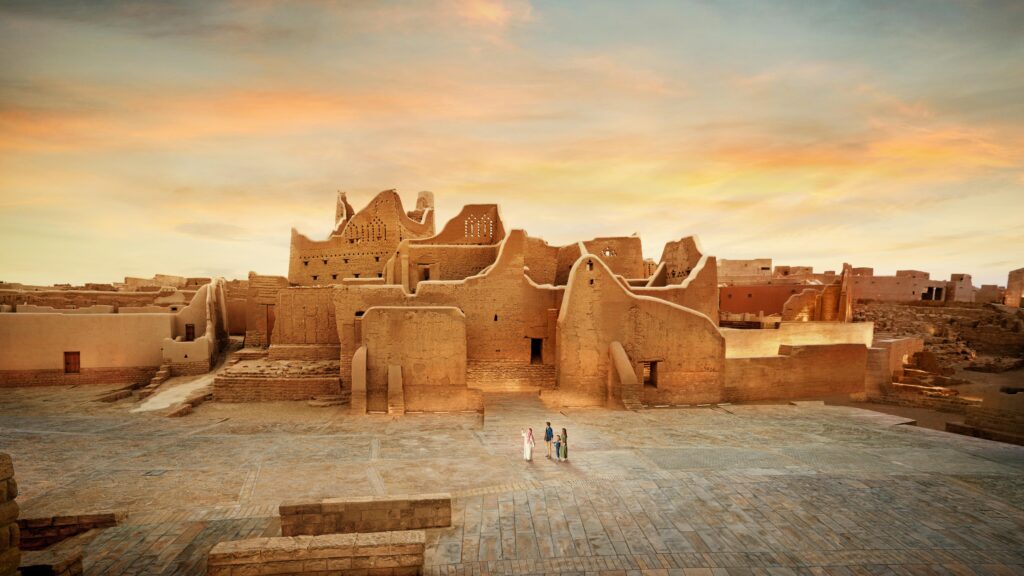
That destiny crystallised in the 18th century, when At-Turaif became the seat of the First Saudi State (1727–1818). Today, At-Turaif stands as a UNESCO World Heritage Site and the symbolic birthplace of modern Saudi Arabia. Walking its restored palaces and fortifications, the significance of the place is almost tangible. This was not simply a capital; it was the cradle of a nation.
Today, Diriyah is undergoing one of the most ambitious cultural and urban transformations on the planet. Spread across 14 square kilometres, the masterplan is designed to welcome 50 million visitors annually, support more than 180,000 jobs and contribute an estimated $18.6 billion to Saudi Arabia’s GDP once complete.
Since the start of 2024, Diriyah Company has awarded construction contracts worth $27 billion, with over $5 billion approved in the first half of this year alone. On the ground, the scale is staggering. The project operates across three shifts, with close to 80,000 workers at any one time — nearly a quarter of a million people moving through the site in a 24-hour rhythm. More than ninety cranes trace the skyline, rising above the historic mudbrick silhouette in a carefully choreographed contrast of old and new.
What is perhaps most impressive is how heritage has shaped the build itself. Millions of cubic metres of earth have been excavated and repurposed on site to recreate Diriyah’s signature Najdi mudbrick aesthetic using modern, sustainable techniques. The result is architecture that feels authentic in colour, texture and scale, while meeting contemporary environmental standards.
Beneath the pedestrian-only streets lies a four-level subterranean infrastructure: concealed parking, utilities, cooling systems and a future-ready connection to the Riyadh Metro. The city has been built downward so that life above can unfold calmly, free of visual and acoustic clutter.
Inside the visitor centre, Development & Innovation Marketing Executive Director Nawaf Rajeh walked me through the full masterplan model, a vast architectural sculpture mapping every future museum, hotel, boulevard and neighbourhood. Stepping outside and seeing that miniature vision already rising in real time is a moment that stays with you.
As Jerry Inzerillo puts it: “Our vision is to build a vibrant, walkable city where people can live, work, learn and celebrate culture in one extraordinary destination.”
Bujairi Terrace: the social heartbeat
My first taste of Diriyah’s present was Bujairi Terrace, perched above Wadi Hanifah with sweeping views of At-Turaif. Najdi architecture frames a world-class dining scene, where Saudi concepts sit alongside international names. It is polished but relaxed, equally suited to business lunches and lingering sunset dinners. Outdoor cooling keeps open-air plazas comfortable even in peak summer, underscoring how thoughtfully the destination has been designed.
Culture, hospitality and global ambition
Diriyah’s future reads like a blueprint for a new kind of cultural capital. Nearly 40 luxury hotels are planned, alongside 18,000 residences — including 300 branded homes — half a million square metres of retail and dining, more than 1.6 million square metres of office space, a university, 16 schools, four healthcare assets and over two dozen cultural institutions.
This is not a speculative city. It is a place being built with intention, where heritage anchors identity and modernity provides expression.
Wadi Safar: the future of ultra-luxury living
One of the most compelling areas I visited was Wadi Safar, set to become Saudi Arabia’s most exclusive lifestyle estate. Even now, the landscape feels expansive and serene. A Greg Norman–designed golf course is emerging alongside the Royal Diriyah Equestrian and Polo Club, while 42 kilometres of cycling, hiking and riding trails weave through the valley. Ultra-luxury branded residences will sit lightly within the terrain, drawing the world’s most discerning travellers to a setting where nature and architecture are in quiet dialogue.
At-Turaif: where the past comes alive
At-Turaif itself has been reimagined as an immersive heritage district. Restored palaces, mosques and defensive towers are paired with museums, expert-led tours and the Arabian Horse Gallery. Subtle lighting transforms the site after dark, allowing the architecture to glow against the desert sky.
More than a million visitors now pass through At-Turaif each year. Its success lies in balance — authenticity without stagnation, history animated by contemporary cultural programming. It feels less like a preserved site and more like a living stage for Saudi Arabia’s evolving identity.
Where heritage and ambition meet
From the emerging Diriyah Square and the Bab Samhan hotel to the future Royal Diriyah Opera House and the vibrant Souq Al Mawsim, every district offers a glimpse of a destination that will soon rival the world’s great cultural capitals.
Diriyah is not a theme park or a reconstruction. It is a living place with deep roots and bold intent. Standing there, between the preserved birthplace of a kingdom and the city rising around it, I felt the rare privilege of watching a national narrative unfold in real time.
Diriyah is where Saudi Arabia began. Now, it is where the world will gather.