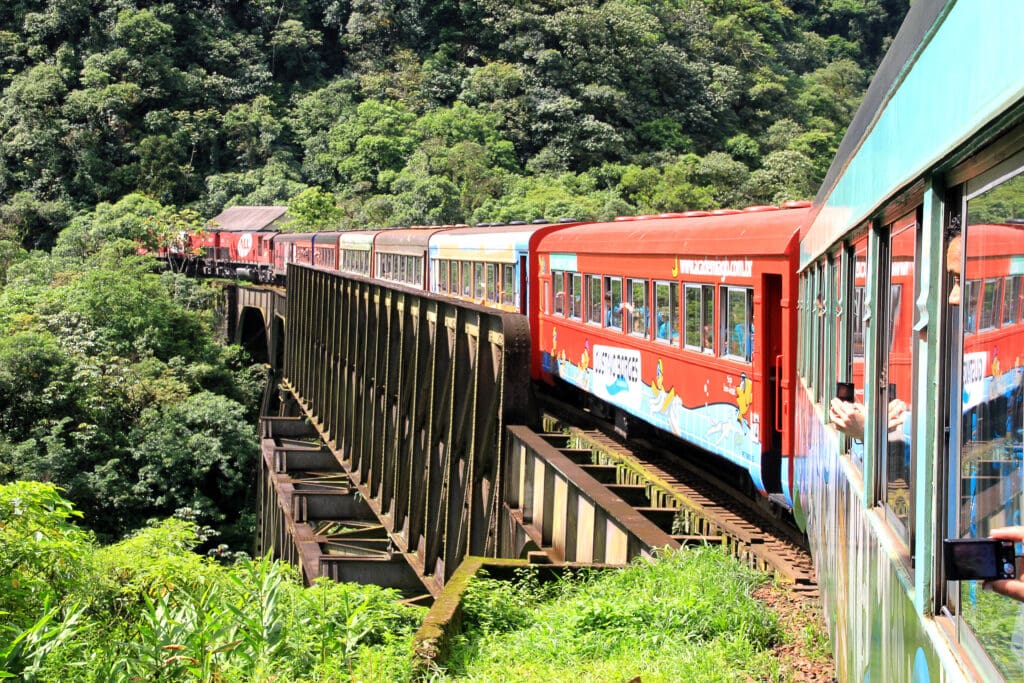
Operated by Serra Verde Express, the journey covers 70 kilometres between Curitiba and Morretes, in Paraná
The Serra do Mar Paraná Railway is one of the most enchanting train experiences in Brazil. With 140 years of history, this railway is a true masterpiece of engineering, attracting tourists from around the world in search of a journey that blends history, nature and local culture. Operated by Serra Verde Express, the train covers 70 kilometres between Curitiba and Morretes, in Paraná, passing through breathtaking landscapes, including canyons, waterfalls, and century-old bridges, and it was featured at BBC’s Celebrity Race Across the World in 2024.
The final stop of the trip is the coastal town of Morretes, a municipality founded by Jesuits in 1733, where the streets and architecture preserve the history of Paraná’s development.
Visitors can stroll through the town square, explore local handicrafts, and savour the region’s iconic dish: Barreado. This delicacy harks back to the days of the tropeiros (colonial muleteers) – a slow-cooked beef stew prepared in a clay pot, seasoned with spices, and served with cassava flour and bananas.
The railway route through Paraná’s Serra do Mar has been travelled by over 4 million people in the nearly 30 years of Serra Verde Express’ operation. Just last summer, more than 70,000 passengers made the trip to Morretes or returned by train to Curitiba, and in 2025 alone, almost 280,000 passengers took the tour.
The Serra Verde Express Train
The train has a capacity of up to 1,200 passengers, varying according to demand. Its 25 cars traverse the Serra do Mar on a 4-hour journey, reaching a maximum speed of 30 km/h. Passengers can choose among three classes of cars: Tourist, Boutique or Luxury Railcar (Litorina).
The Boutique and Luxury Railcars provide a premium experience, each with distinctive, themed interiors – some adorned in vintage style, others featuring open balconies for unobstructed views of the Atlantic Forest. In the Boutique class, passengers are treated to onboard service that includes unlimited water, juice, soft drinks, beer, and a curated snack. This category also includes special cars such as the Bove Car, which is pet-friendly, and the Carmen Silva Car, designed for accessibility. The Luxury Railcars, known as Litorinas, are self-propelled units that deliver an even more exclusive and refined journey.
Along the way, the train crosses 41 bridges, passes through 13 tunnels, and reaches its highest point at 952 metres above sea level, in one of the best-preserved stretches of Atlantic Rainforest in the country. The tallest bridge is São João, standing 113 metres tall.
History of the Railway
The story of the railway connecting Curitiba to Paraná’s coast begins with the Rebouças brothers, sons of a self-taught man and grandsonsof a freed enslaved woman married to a tailor of the Portuguese court. Privileged with the opportunity to study in Europe and specialise in engineering in Rio de Janeiro during the era of slavery, the brothers played a crucial role in this project.
In 1865, André Pinto Rebouças analysed a map and noticed that the coastal city of Antonina, in Paraná, aligned with Asunción, Paraguay. He discussed with his brother and father the possibility of building a road linking these cities, believing it would be anefficient route for cargo transport. However, due to the Paraguayan War, the project stalled.
In 1871, yerba mate barons and politicians in Curitiba debated the urgent need to transport yerba mate to the coast, as countries like Uruguay, Chile, England, and France were the main consumers. Land transport was done by mules, and there were no road connecting Curitiba to the coast – only indigenous trails.
In 1873, Antonio Pereira Rebouças Filho, André’s brother, presented the project for the Dona Isabel Railway to the president of Paraná province, based on André’s earlier proposal. However, Antonio died of malaria in 1874, leaving the project in the hands of Irineu Evangelista de Souza, the Baron of Mauá, a pioneer of Brazilian railways.
In 1875, a dispute between Antonina and arranagua led to the imperial decision that the railway would depart from Paranaguá,not Antonina. In 1879, a BelgianFrench company, Compagnie Générale de Chemins de Fer Brésiliens, took over the concession, with engineer Antonio Ferrucci as general director.
On June 5, 1880, Emperor Dom Pedro II laid the railway’s cornerstone in Paranaguá, honouring the Rebouças brothers’ request to avoid enslaved labour (unless paid). After five years of construction, the railway was inaugurated on February 2,1885, remaining to this day a masterpiece of Brazilian engineering,celebrated for its execution by national engineers.
Andrea can be found either in the Travelling For Business office or around the globe enjoying a city break, visiting new locations or sampling some of the best restaurants all work related of course!
We use cookies to ensure that we give you the best experience on our website. If you continue to use this site we will assume that you are happy with it.