


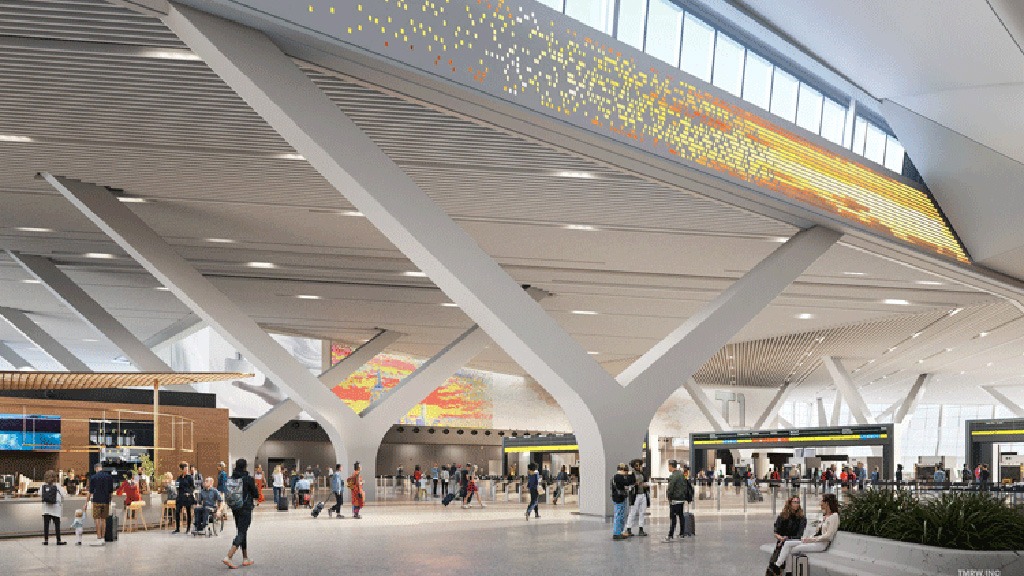
When travellers step into The New Terminal One at John F. Kennedy International Airport, they will encounter more than a gateway to the world. They will enter a space deliberately designed to speak the language of New York, its energy, diversity and constant motion, with culture woven directly into the fabric of the terminal.
Set to open in phases from 2026, the New Terminal One is the largest terminal in JFK’s history and a cornerstone of a $19 billion redevelopment led by the Port Authority of New York and New Jersey. When complete, the all-international terminal will handle up to 23 million passengers a year. Privately funded by a consortium including Ferrovial, JLC Infrastructure, Ullico and Carlyle, it is the largest public-private partnership in US aviation history.
But scale alone is not what sets the project apart. From the outset, the Port Authority’s ambition was to create an airport that delivers not only operational excellence, but a powerful sense of place. Culture, design and storytelling are not decorative afterthoughts here; they are core infrastructure.
Rather than commissioning public art, branding and digital media as separate programmes, the New Terminal One team conceived them as a single, continuous cultural experience. That approach brought together a multidisciplinary group of creatives, engineers, designers, curators and artists, working collaboratively to ensure that art, architecture and technology evolved together.
Working with Arup alongside studios including Pentagram, Culture Corps, Gentilhomme, Karlssonwilker and WeShouldDoItAll, the terminal’s creators embedded cultural expression directly into the building’s structure. The result is a terminal that feels unmistakably New York without relying on clichés, offering subtle nods to the city’s character at every turn.
At the heart of this vision is a major public art programme that positions the terminal as both transport hub and cultural destination. Seven internationally acclaimed artists, including Yinka Shonibare, Kelly Akashi, Tomás Saraceno, Ilana Savdie, Julie Curtiss, Firelei Báez and Woody De Othello, have been commissioned to create monumental, site-specific works.
Their sculptures, murals and mosaics punctuate the terminal’s spaces, guiding movement and shaping moments of pause. United by the theme We Travel Under One Sky, the artworks celebrate connection, migration and shared humanity, echoing the diversity that defines New York itself.
Rather than competing with the architecture, the works establish a visual rhythm that transforms the act of moving through the terminal into a curated journey.
Branding at the New Terminal One functions as a living system rather than a static identity. The design language carries through everything from wayfinding and monumental signage to mosaic floor inlays, creating a sense of movement that mirrors the city’s pace.
Queens-based studio Karlssonwilker has embedded playful, poetic messages throughout the terminal in unexpected places, from electrical outlets to furniture upholstery, offering moments of discovery that feel authentic to New York’s voice.
One of the most striking features will be the world’s largest split-flap display in the Departures Hall. Part of the Leaving New York installation, it delivers a kinetic farewell that frames travel as transformation. Elsewhere, lenticular graphics such as The City in Bloom capture the city’s perpetual reinvention, while baggage claim floors reference familiar urban motifs.
If art and branding define the terminal’s visual identity, digital media gives it emotional depth. Immersive installations extend the story of departure and arrival, blending architecture with moving image and sound.
The Leaving New York experience layers cinematic scenes of the city and state across massive split-flap displays, accompanied by a soundscape that evokes movement through land, sea and air. On arrival, tranquil panoramas of New York’s natural landscapes ease the transition from journey to homecoming, while digital banners in the Customs Hall welcome passengers in the native languages of arriving flights.
A standout element is the Love Letters to New York film series, developed with support from the Jamaica Center for Arts and Learning. Featuring short films by local filmmakers from Queens and surrounding communities, the series brings authentic, place-based storytelling into the hold rooms, turning the airport into a platform for local creative voices.
The New Terminal One represents a shift in how major airports think about experience. Here, culture is not layered onto infrastructure; it is inseparable from it. Art, design and technology operate as a single system, reinforcing identity while enhancing wayfinding, comfort and emotional connection.
The result is a terminal that feels both local and global, deeply rooted in New York, yet designed for an international audience. As airports worldwide compete to improve efficiency and passenger satisfaction, JFK’s New Terminal One sets a new benchmark, showing that infrastructure can be expressive, human and culturally resonant.
When it opens, passengers won’t just pass through New York. They’ll feel it, long before they ever leave the ground.