


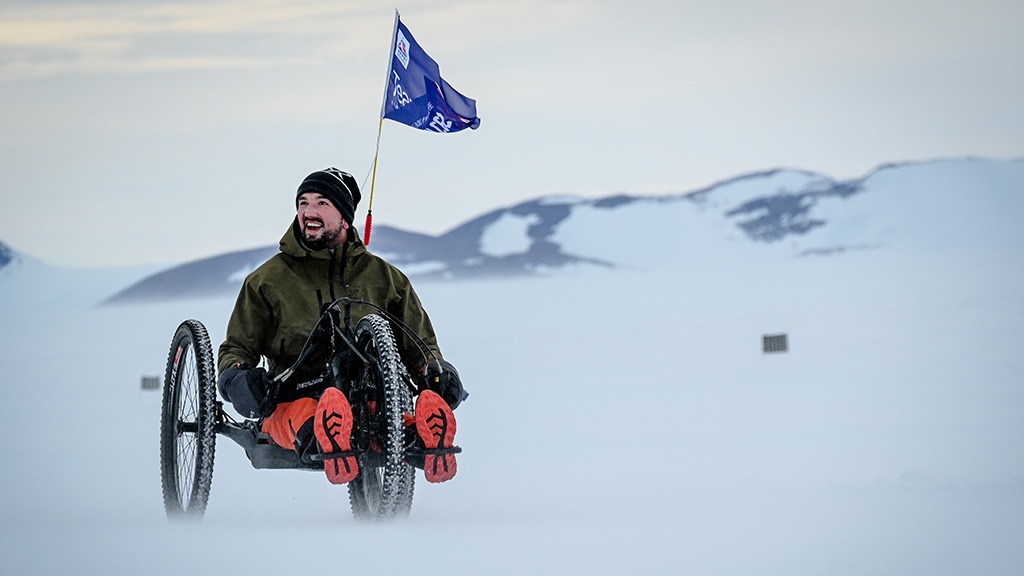
By the time the Twin Otter banks away and its engine noise fades into the white, Darren Edwards and his team will be alone on the coldest, driest continent on Earth.
Ahead of them: 222 kilometres of featureless Antarctic plateau, temperatures nudging -30C, and an audacious plan to push a sit-ski to the South Pole further than anyone has ever done before.
“To me it feels like the last great wilderness on Earth,” he says. “You look in every direction and it’s just this otherworldly wasteland of snow and ice and outcrops of rock. Once you’ve seen it, it’s hard to move on from it.”
Edwards, 35, is no ordinary polar hopeful. A former mountaineer and Army Reservist, he was paralysed from the chest down in 2016 when a section of rock collapsed beneath him while climbing in North Wales. The fall shattered his back, severed his spinal cord and ended, in a split second, the life he thought he was building in the hills.
Nine years on, he sits at the vanguard of adaptive adventure. Since his accident he has kayaked 1,400km from Land’s End to John O’Groats, led a team of injured veterans across some of Britain’s roughest seas, completed the World Marathon Challenge in a wheelchair – seven marathons, seven days, seven continents – and become part of the first adaptive team to cross Europe’s largest ice cap, Vatnajökull in Iceland.
Now he is preparing for his hardest undertaking yet: an unsupported world-record sit-ski expedition from 88° South to the Geographical South Pole. The journey, which he has dubbed Redefining Impossible, will see him attempt to double the furthest distance a sit-skier has ever travelled to the Pole.
“The fascinating bit is we don’t actually know if it’s possible,” he admits. “There have only ever been two sit-skis to the South Pole and both did the last degree – 111 kilometres. We’re trying to go twice as far, using a fraction of my body to power the sled. You’re relying on your shoulders and triceps to do everything. It very much embodies the name of the expedition.”
If this sounds punishing for an able-bodied explorer, that’s because it is. At 9,000ft, the Pole sits high enough to sap strength and oxygen. The air is so dry that skis – or in Edwards’s case, the twin backcountry boards bolted beneath his wheelchair frame – barely glide.
“Antarctica is the largest desert in the world,” he says. “Every slide of your skis or every push of my poles, you get less glide than you would in somewhere like Norway or Iceland. You’re skiing uphill, in brutal cold, pulling an 80–90kg pulk that weighs as much as a grown adult.”
Then you add spinal cord injury to the mix. Edwards can’t feel or move anything below his chest. “If I was developing frostbite on my feet, I wouldn’t know,” he says. “Pressure sores are a big risk because I’m sitting in the sit-ski for eight to ten hours a day. And then there’s the stuff that’s not glamorous but is very real – bladder and bowels. At home I’ve got systems, techniques, kit. In Antarctica, it’s stripped-back adventure: no custom toilets, no grab rails, no comforts. It’s a lot of extra layers of risk and anxiety.”
A sit-ski, as he describes it, is essentially a wheelchair on skis. “Imagine a bloke in his mid-30s in a wheelchair – that’s an accurate description of me,” he laughs. “Take away the wheels and put two thicker skis beneath. I use reinforced ski poles, lean into them, dig them into the snow and do a kind of lat pull-down followed by a tricep extension. You drive through the movement until your arms are fully extended and the sit-ski slides forward. You’re only as fast and as strong as your upper body, and it’s going to take a battering.”
The daily rhythm will be unrelenting. With fellow adventurers Lucy Shepherd and Dwayne Fields, and filmmaker Matthew Biggar, Edwards will haul everything they need from the moment the plane leaves: tents, fuel, clothing, medical kit and three weeks’ worth of food.
“There’s no real rest,” he says. “From the moment we wake up we’re melting snow for drinking water and for meals, getting ourselves ready, breaking camp. We’ll probably start skiing around nine in the morning, go for 55 minutes, then stop for five – food, drink, a few minutes of admin. Then repeat that eight, nine, ten times. When we stop for the day, you’re straight into putting up the tent, melting more snow, prepping for the night and the next day.”
The 55/5 rhythm came from a mountain guide on a previous expedition. “There’s no science to it beyond ‘it works’,” he says. “That doesn’t mean we won’t change it out there if we have to.”
Psychologically, this is, he says, “on another level” to anything he has done before. Crossing Britain by kayak, rowing the Channel, even the World Marathon Challenge came with something resembling a safety net. “You’re close to home, you’re close to support. There’s always the ability to say, ‘I’m out, I’m done, I can’t go on.’ In the South Pole, as soon as the plane drops us off we’re unsupported and unassisted. The isolation is higher, the risk is higher, the need for the team to work together to overcome my physical limitations is higher.”
Antarctica is as much a mental landscape as a physical one. Out on the ice, conversation is limited to the brief stops. The rest of the time, each skier is alone with their thoughts, moving through a world of white and wind.
“In Iceland, everyone else was listening to podcasts or music,” Edwards recalls. “I just had nothing – no headphones, no noise apart from the whistle of the wind and the sound of the skis. At times it was pure silence. It was like an extreme form of therapy. You feel your skin tingling with the environment. I think in Antarctica I’ll spend a lot of time deep in my own thoughts.”
Those thoughts will be coloured by the fact that this is his first expedition as a father. Earlier this year he and his wife adopted a baby boy. “That changes the mental dynamic a lot,” he says quietly. “Before, I knew I had a strong, capable, independent wife at home who would miss me but didn’t need me. Now I’m very conscious that I’m leaving a very vulnerable child who needs support, love and care. That’s a very personal, non-obvious psychological challenge for me on this one.”
His route to the ice began, improbably, in a kayak shop while he was still an in-patient. As he neared the end of rehab, his surgeon’s words – “keep your head facing the future into the doors that have just opened” – finally began to make sense.
“I called Matt, the friend who saved my life on the cliff, and said: ‘There’s something I need to do.’ We went to a kayak shop. I bought a sea kayak, a paddle and a buoyancy aid. I’d never kayaked in my life. The physios thought I was absolutely bonkers,” he says. “But there was something about that image of getting out of a wheelchair, into a boat and casting off that represented the freedom and independence I was craving, even though I was still in hospital.”
The day after he was discharged – Christmas Eve – he was on the water for a two-hour session of “how often is Darren going to fall in?”, which turned out to be: very often. “But that was the spark,” he says. “The kayak became the symbol of independence I never knew I needed. Ultimately it led to that first big expedition and then to everything else.”
With each success has come a growing sense of responsibility. This Antarctic project has a budget of around £300,000 and relies on corporate sponsors, attracted by the idea of their logo at the South Pole next to a team who have “done the unthinkable”.
“There is a lot of pressure to succeed,” he admits. “You’re representing brands, you’re representing a community. When you attempt to redefine the impossible there is a significant chance of failure, and on this one the percentage risk is higher than on any of the others. There are more factors out of our control. That makes me nervous.”
At the heart of the expedition is Wings for Life, the spinal cord research charity backed by Red Bull. Edwards hopes to raise £100,000 for its work. Over the last two decades the foundation has poured money into clinical trials around the world, including a landmark study in Switzerland in which a man, paralysed at the same level as Edwards for 14 years, was able to take assisted steps thanks to an implanted device that ‘bridged’ the damage to his spinal cord.
“For years there’s been this faint hope that one day there’ll be a cure,” he says. “Wings for Life are turning that ‘one day’ into a very legitimate belief that in the next five to ten years something is going to happen. For me, I’ve come to terms with my life as I am, and I’m incredibly happy. I’d take huge pride in watching a future version of me not have to go through what I went through – to have an operation, do rehab and walk back out through those hospital doors.”
His message for someone newly injured, lying in a hospital bed as he once did, is simple. “There were some really dark and desperate moments for me where I just couldn’t see how I could still be me,” he says. “I hope this expedition can be a beacon of hope – not just for the spinal injury community but for anyone going through adversity they never saw coming. I want them to see that there’s always a way through, and that with the right support and teamwork you can still achieve incredible things.”
His relationship with wild places has deepened with the effort it now takes to reach them. “When something becomes more difficult to access, your level of gratitude rises,” he says. “The old me was always powering on, trying to do everything quicker and faster, and forgetting to stop and go ‘wow’. Now I stop more. I look, I pause, I reflect, because I feel so fortunate just to be there.”
If he could offer Travelling for Business readers five minutes on the expedition, he wouldn’t put them on the trail at all. “I’d take them into the tent,” he says. “Those last five minutes before I get into the sit-ski. Moving around a tent with two limbs that aren’t playing ball, getting out into the cold, strapping everything together – it shows more about what it means to live with a spinal cord injury than watching me ski. Once I’m moving, people think, ‘He’s got it.’ But the hard stuff is often the bit you never see.”
And that final moment at 90° South? He has replayed it countless times in his head. “I think I might cry, to be completely honest,” he says. “It’s been more than a two-year project, with sponsors pulling out, injuries, becoming a dad – lots of setbacks where other people might have said, ‘That’s it, it’s over.’ For me, touching the Pole will be this massive moment of relief that will probably flow into a few quiet tears – relief, pride and that sense of achievement you get from doing these weird and wonderful things.”
Then, after redefining impossible once again, he will turn for home – back to his wife, his young son and, inevitably, to whatever challenge his mind begins to dream up next.