


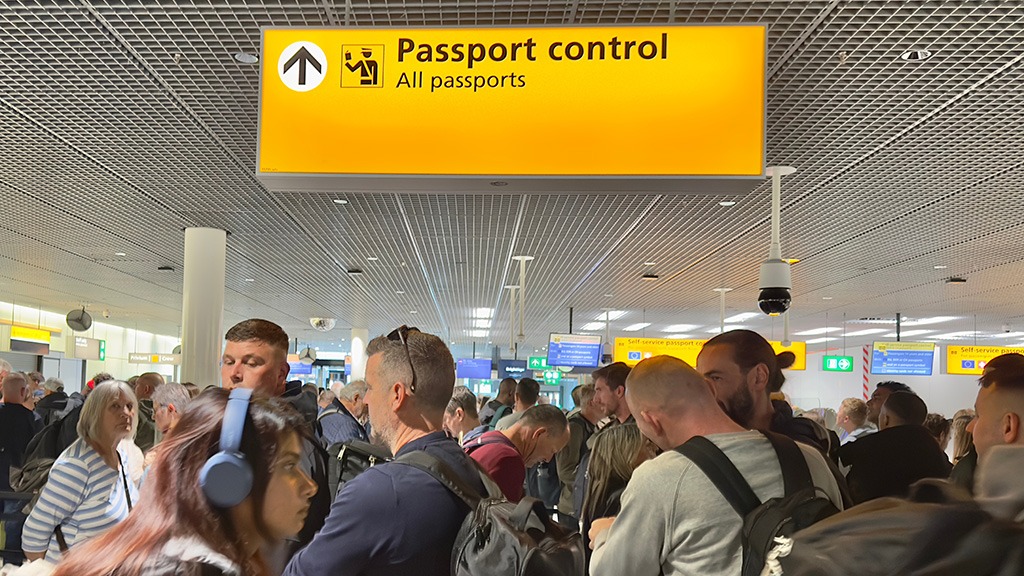
Passengers travelling to Europe are being warned to expect lengthy delays at airport passport control during upcoming holiday periods, as the European Union’s new biometric Entry-Exit System (EES) continues to be introduced.
Travellers have already reported waits of several hours at some airports during busy periods, prompting concern from airport operators and travel industry groups. The system, which replaces traditional passport stamping for non-EU visitors, requires biometric registration, including fingerprints and a facial image, on first entry to the Schengen Area.
Videos circulating on social media in recent days show passengers facing queues of up to three hours at Geneva Airport, a key gateway for winter ski travel. Airport authorities there acknowledged that the introduction of EES has caused “congestion, particularly on Saturdays during the busy ski season”.
A spokesperson for Geneva Airport said implementing the system had been a “major challenge” for both Swiss customs and the airport operator, with additional staff being deployed in an attempt to ease pressure.
Similar problems have been reported at Tenerife Airport. Andrew Knight, who runs Salasti car hire at the airport, said queues have been highly inconsistent. “Some passengers are getting through in about 20 minutes, while others are waiting one and a half to two hours,” he said, adding that occasional system outages have worsened delays when multiple flights arrive at once.
The EES has been in a phased rollout since October, with around half of EU border points currently operating the system and at least one-third of non-EU passengers using it. Registration is valid for three years, after which biometric details must be renewed.
However, Airports Council International Europe has warned that the system significantly increases processing times. Its director general, Olivier Jankovec, told the BBC that border control processing is now “four to five times longer”, with typical waits of up to two hours.
Jankovec cited a lack of trained border staff and unreliable kiosks as key factors, and warned the situation could deteriorate sharply during the Easter and summer travel peaks. Without intervention, he said, queues of five to six hours were a real possibility.
The European Commission has sought to reassure travellers, saying the system has so far operated “largely without issues”. According to the Commission, around 23 million entries and exits have already been registered under EES, with 12,000 refusals of entry recorded.
Markus Lammert, the Commission’s spokesperson for internal affairs, confirmed that while EES is due to be fully in use at all border points from 10 April, member states are allowed to partially suspend its operation during peak periods. This flexibility could be used until September to manage excessive queues.
Jankovec said such measures would be essential if conditions at border control became “unsustainable”, urging close coordination between airports and border authorities to ensure suspensions can be triggered quickly when needed.
The UK travel trade body ABTA said border authorities were not making full use of contingency measures already available, leaving passengers “caught up in lengthy delays”. It called for improved planning around peak travel periods and more proactive use of flexibility in the system.
Julia Lo Bue-Said, chief executive of the Advantage Travel Partnership, advised travellers to prepare for disruption. “Without question, the new system has created additional bottlenecks in places that were already under pressure,” she said. “Plan for the worst, especially during peak times. Bring refreshments, and something to keep children occupied.”
As Europe heads into a busy travel season, passengers are being urged to allow extra time at airports and brace for delays while authorities continue to refine the rollout of the EU’s most significant border control change in decades.