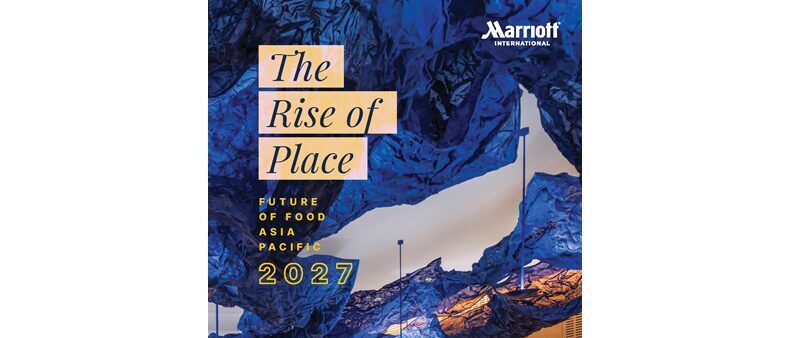
Marriott International has released its Future of Food 2027 report, revealing a major shift in how travellers across Asia Pacific (excluding China) choose where and how they dine.
The study highlights a growing demand for hyper‑local, authentic food experiences and a move away from traditional restaurant formats toward more fluid, social spaces.
According to the report, 95% of surveyed Marriott properties say guests increasingly prioritise local signature dishes, making regional cuisine the strongest dining trend in the market . Diners are seeking deeper cultural connection, with hotels responding by building menus around local ingredients and destination‑driven storytelling — from Kyoto vegetables to Kampot sea salt and indigenous spices across Southeast Asia.
At the same time, dining is breaking out of formal restaurant settings. Guests are gravitating toward lounges, bars, counters and flexible spaces, turning hotels into all‑day social hubs. Nearly half of surveyed properties report rising demand for casual venues, while Vietnam shows particularly strong growth in bar‑and‑lounge dining at 71% . Technology is quietly underpinning this shift, with 100% of restaurants and bars in Thailand already using AI to support menu development, staffing and guest insights.

The report also identifies a new wave of 99‑minute fine dining, with 58% of properties delivering premium multi‑course meals in under two hours, reflecting a regional preference for shorter, high‑impact experiences over lengthy tasting menus.
Additional trends include wellness‑driven menus — now offered by 97% of Marriott properties — plant‑forward dining, and rising demand for sophisticated low‑ and no‑alcohol alternatives.
Marriott says Asia Pacific’s F&B future will be defined by authenticity, intentionality and deep connection to place, with hotels acting as cultural storytellers through design, ingredients and local talent.