


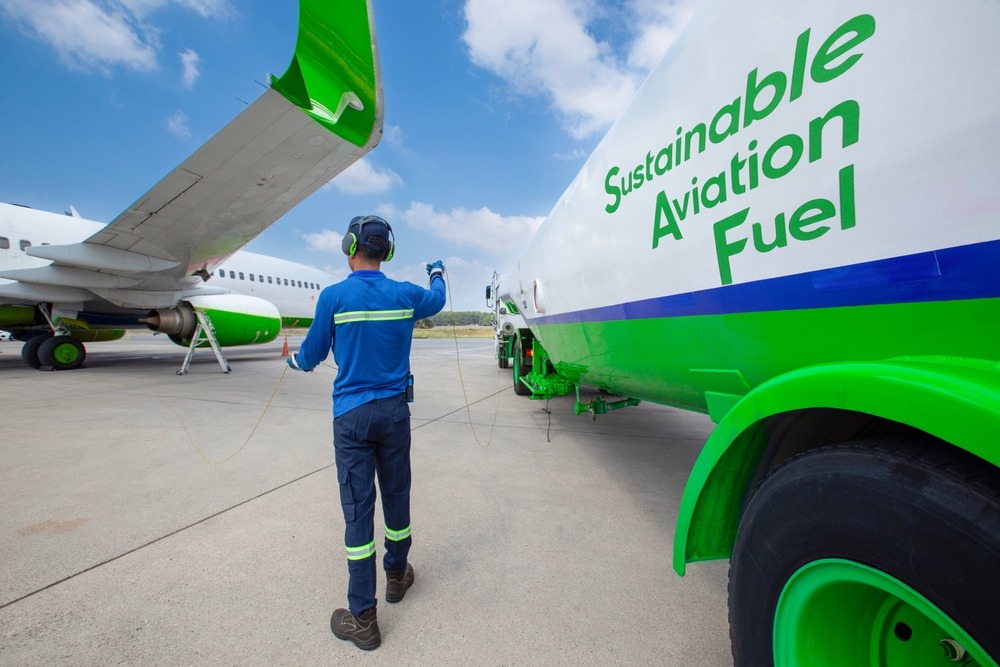
The International Air Transport Association (IATA) has sounded the alarm on the future of Sustainable Aviation Fuel (SAF), releasing new estimates that highlight both progress and pressing challenges.
For business travellers and the companies that rely on global connectivity, the findings carry significant implications for cost, sustainability, and long-term travel planning.
Production Growth Stalls
In 2025, SAF output is expected to reach 1.9 million tonnes (2.4 billion litres)—double the 1 Mt produced in 2024. Yet growth is already slowing, with production projected to reach only 2.4 Mt in 2026. Despite this increase, SAF will represent just 0.6% of total jet fuel consumption in 2025, rising marginally to 0.8% in 2026.
At current price levels, the SAF premium translates into an additional USD 3.6 billion in fuel costs for the industry in 2025. This is a downward revision from earlier forecasts, driven by a lack of policy support to fully leverage installed SAF capacities.
The Cost Burden on Airlines
SAF prices remain significantly higher than fossil-based jet fuel—twice as expensive on average, and up to five times higher in mandated markets. For airlines, this translates into billions in additional costs. In 2025 alone, carriers paid a premium of USD 2.9 billion for the limited SAF available, with USD 1.4 billion reflecting the standard price premium.
For business travellers, these costs inevitably filter down into ticket prices, corporate travel budgets, and the overall economics of international mobility.
Policy Missteps in Europe and the UK
IATA has been particularly critical of SAF mandates in the EU and UK.
- ReFuelEU Aviation has sharply increased costs amid limited SAF capacity and oligopolistic supply chains. Airlines are paying up to five times more than conventional jet fuel, without guaranteed supply or consistent documentation.
- In the UK, SAF mandates have triggered price spikes, leaving airlines to absorb the burden.
“Europe’s fragmented policies distort markets, slow investment, and undermine efforts to scale SAF production,” said Willie Walsh, IATA’s Director General. “Actions, not words, are what matter.”
Airline Commitments Under Pressure
The failure to accelerate SAF production capacity is forcing airlines to reconsider their sustainability pledges. Many carriers had committed to using 10% SAF by 2030, but with current production volumes, these targets are increasingly unrealistic.
“Regrettably, many airlines that have committed to use 10% SAF by 2030 will be forced to re-evaluate these commitments. SAF is not being produced in sufficient amounts to enable these airlines to achieve their ambition,” Walsh added.
For corporate travel managers, this means sustainability reporting and carbon offset strategies may need to be recalibrated in the coming years.
Looking Ahead: e-SAF Mandates
The next frontier is electro-fuels (e-SAF), with mandates approaching in the UK (2028) and EU (2030). Yet the outlook is daunting:
- e-SAF faces a cost base potentially 12 times higher than conventional jet fuel.
- Without strong production incentives, supply will fall short of targets.
- Compliance costs could escalate to EUR 29 billion by 2032 if targets are missed.
Marie Owens Thomsen, IATA’s Senior Vice President for Sustainability and Chief Economist, warned: “Given the low SAF production volumes, it is evident that current policies are not having the desired effect. Mandates have done just the opposite, and it is outrageous to repeat the same mistakes with e-SAF mandates.”
What This Means for Business Travel
For the business travel sector, SAF is both a challenge and an opportunity:
- Costs: Rising fuel premiums will impact airfare, particularly on long-haul routes.
- Sustainability: Corporate travel programmes may struggle to meet emissions targets without reliable SAF supply.
- Policy: Engagement with regulators will be critical to ensure workable incentives rather than punitive mandates.
- Strategy: Companies may need to diversify sustainability efforts, combining SAF with carbon offsetting, virtual meetings, and alternative travel modes.
The IATA’s latest estimates underscore a sobering reality: while SAF is essential to aviation’s decarbonisation, current policies are stalling progress. For business travellers, this translates into higher costs and uncertainty around sustainability commitments.
As the industry looks ahead to e-SAF mandates, the message is clear: without effective incentives and coordinated policy, the future of sustainable business travel remains at risk.