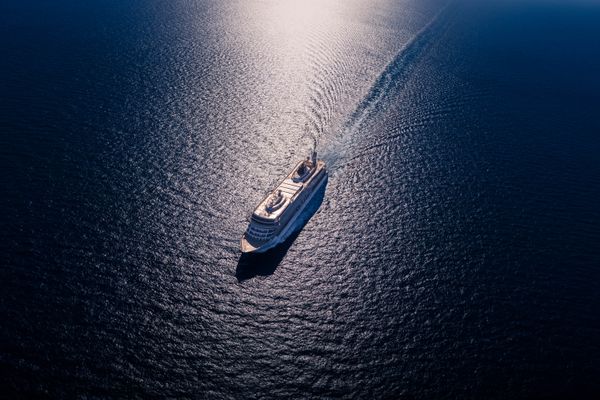
Viking has taken delivery of the Viking Libra, which the cruise line and its builder Fincantieri describe as the world’s first hydrogen-powered cruise ship.
The handover took place at Fincantieri’s shipyard in Ancona, Italy, where the ship has been under construction. It now joins Viking’s ocean fleet and will spend its first season sailing itineraries in the Mediterranean and Northern Europe, the same regions as its sister ships.
How the Viking Libra uses hydrogen
The ship has a hybrid propulsion system that uses liquefied hydrogen stored on board and fuel cells, both to move the ship and to generate power on board. The system was developed with Isotta Fraschini Motori, a Fincantieri subsidiary that specialises in propulsion technology.
One of the obstacles to using hydrogen at sea is refuelling, because few ports have the infrastructure to supply it. To get around this, the ship uses a containerised fuel storage system to load and store the hydrogen. The technology is designed to allow zero-emission operation in environmentally sensitive areas.
Fincantieri had earlier tested hydrogen at a much smaller scale, fitting an experimental 100 kW fuel cell module to the Viking Neptune. A sister ship, Viking Astrea, is under construction in Ancona with the same system and is due in 2027. Viking expects both ships to operate on hydrogen from 2027.
“The delivery of the Viking Libra is a proud moment for Viking and an important milestone in our growing ocean fleet,” said Leah Talactac, Viking’s president and chief executive. She added that the ship and Viking Astrea would help set a new benchmark for innovation while allowing the company to welcome more travellers.

A small ship by cruise standards
Like Viking’s other ocean ships, the new vessel is small by modern cruise standards. It has 499 staterooms for 998 guests, a gross tonnage of about 54,300 and a length of 239 metres.
The project was announced in April 2025, when Viking and Fincantieri also signed contracts for two more ocean ships for delivery in 2031, with an option on two more for 2033. Italian business daily Il Sole 24 Ore put the value of that contract at around 1.5 billion euros. The ship was floated out in Ancona in March 2026, with delivery then scheduled for November.
At the float out, then chairman and chief executive Torstein Hagen said the line’s approach to ship design had always focused on reducing fuel consumption, and called the ship its most environmentally friendly vessel yet. Hagen is now executive chairman.
What it means for the travel industry
Viking is expanding quickly. The company says it expects to take delivery of 25 more river ships by 2030, ten more ocean ships by 2032 and two expedition vessels by 2031.
The project is being watched well beyond cruising. Shipping and aviation both face pressure to cut emissions, and hydrogen is one of the options under study in both. How well the ship performs in service, and how easily it can be refuelled, will shape how quickly others follow.
For companies, the most direct relevance is in meetings, incentives and events, where cruise ships are sometimes used for incentive trips and conferences, and where clients increasingly ask about the emissions of the venues they use. Viking’s river fleet has also grown this year, with new ships delivered for its Egypt programme and in Europe.