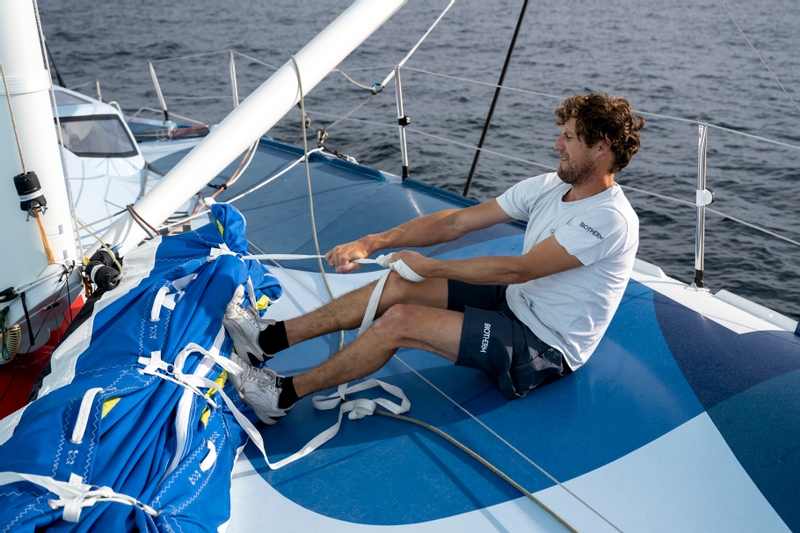
When Paul Meilhat wakes to the soft hiss of water on carbon fibre, the world outside is a palette of greys and silvers. The horizon curves endlessly, and the nearest continent is a rumour.
For most of us, travel is about arrival – passports stamped, hotel lobbies cooled by air-conditioning, emails checked over an espresso. For Meilhat, skipper of the French IMOCA 60 Biotherm and winner of The Ocean Race Europe 2025, travel is perpetual motion, measured not in miles but in weather fronts.
“I suppose I do see the world,” he says with a wry smile. “But not in the way people imagine. Sometimes it’s three weeks of nothing but ocean and clouds. Yet even then, you feel the world. Each port you reach – Genoa, Kiel, Aarhus – carries its own scent, its own welcome.”
That notion – to experience the planet by stitching its coastlines together – sits at the romantic heart of The Ocean Race, that four-decade-old epic of endurance and navigation that threads through the globe like a moving map. To cross its legs is to move between elements as much as between nations. “We connect one country, one culture to another,” Meilhat continues. “Even if the stopovers are short, the sense of journeying across the world is very real.”
At sea there are no schedules in the ordinary sense. No breakfast buffets or check-out times. Meilhat describes a world that operates on instinct and discipline: twenty-minute naps stolen between squalls, freeze-dried meals gulped down between sail changes, the constant low hum of machinery and wind. “You forget land routines,” he says. “You become part of the boat’s rhythm. We’re connected to its operation 24 hours a day.”
It is a kind of sensory minimalism: stripped of comfort but saturated with intensity. Business travellers might recognise a gentler version of the same condition – the blur of airport lounges, time-zone fatigue, that odd intimacy with your own efficiency. But Meilhat’s version is more elemental. “Our days are guided by the sea and the wind,” he explains. “Every decision is about balance, endurance, precision.”
Out there, the digital connection becomes a different kind of lifeline. Weather data downloads replace inboxes; satellite calls substitute the casual chat. And when a storm hits, strategy is everything. “You think in terms of angles and energy,” he adds. “It’s almost meditative – the focus becomes total.”
In the 2025 edition, Biotherm made a brief fly-by at Matosinhos, near Porto. “Three hours,” Meilhat laughs. “Barely enough to smell the coffee.” Yet even those brief brushes with land stay with him. The Portuguese shoreline, the scent of the Atlantic, the low-tide shimmer of the Douro estuary – they’re stitched into his personal atlas. “These are places I’ve passed through many times. The memories overlap, like tides.”
For a traveller accustomed to airports rather than anchorages, it’s a reminder that meaning doesn’t always require time. Sometimes three hours is enough to catch the essence of a place: a gesture, a view, a conversation. “Sailors see the world differently,” he muses. “We’re always moving, but we never really leave it.”
Behind the salt-streaked decks and roaring spinnakers lies a quieter, more pragmatic reality. Ocean racing is also enterprise: sponsorships, partnerships, logistics, crew management – a web of coordination that rivals any corporate operation. “Managing media and partnerships is part of our daily work,” Meilhat says. “Financing a campaign is the lifeblood of the project. You’re not only a skipper; you’re a manager, a spokesperson, sometimes even a fundraiser.”
Between races, the Biotherm team resembles a start-up on the move – content creators editing at sea, communications officers balancing press calls with weather updates. For Meilhat, the balance between competition and communication is delicate. “During a race, you have to juggle everything – physical preparation, technical work, media requests. It’s part of the equation.”
The lesson feels familiar to any executive balancing flights, clients and deliverables: to travel professionally is to choreograph chaos with grace.
And when it’s over? “Sleep,” he says without hesitation. “Food. And a good hot shower.”
He laughs – the kind of laugh that only someone who’s gone weeks without warmth can deliver. “You start to value small things again. The taste of bread. The smell of soap. Those are moments of pure joy.”
For all our premium cabins and polished lounges, we might recognise that truth. The essence of travel, at its deepest level, is contrast: between motion and stillness, deprivation and reward.
Dreaming of Greece
Given free time, Meilhat drifts not to another regatta but to the Aegean. “Greece, of course,” he says softly. “The country is beautiful, the people remain authentic. The islands are hard to reach – no airports, no big chains. You can escape the noise.”
He speaks with the tenderness of someone who understands isolation and connection in equal measure. The Greek archipelago, for him, represents what the sea once promised sailors centuries ago – a constellation of safe harbours after long, uncertain passages.
The wisdom of water
The Ocean Race is not merely a sporting spectacle. It’s a floating study in endurance, diplomacy, and human logistics – an odyssey that fuses elemental challenge with corporate choreography. To watch these sleek carbon hulls carve across the Atlantic is to glimpse travel in its most primal form: purposeful, exposed, and profoundly human.
Meilhat embodies a truth that frequent flyers might do well to remember: travel is less about the distance covered than the awareness sharpened. Whether crossing oceans or terminals, it is the act of moving – between cultures, ideas, and conditions – that expands the self.
As he adjusts a sail under a bruised-pink dawn somewhere off Cape Finisterre, Meilhat is not thinking about jet-lag or status points. He is thinking about wind angles, about the next line of land that will rise from the sea. “Every journey teaches you something,” he says. “Even if it’s just to look differently at the horizon.”
And that, perhaps, is what unites all travellers – sailors and executives alike: the quiet hope that somewhere beyond the next leg, the world will reveal itself anew.