


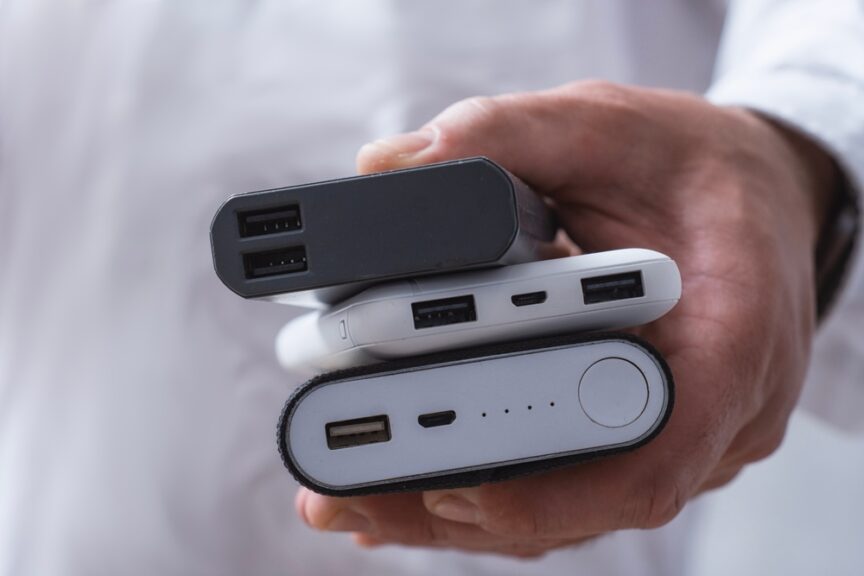
If you still pack three portable chargers and top them up from the seat socket somewhere over the Atlantic, you are flying on 2024 habits. Airline power bank rules have tightened this year.
Since 27 March 2026, updated dangerous goods rules from the International Civil Aviation Organization (ICAO) have limited passengers to two power banks each, required them to travel in the cabin and banned recharging them on board. The UK Civil Aviation Authority sets out the same limits in its dangerous goods guidance, and the International Air Transport Association (IATA) writes the changes into its own Dangerous Goods Regulations from 1 January 2027.
Beneath that sits a rule that has never changed: spare batteries and power banks cannot travel in checked baggage under any circumstances. If your cabin bag is taken at the gate, the batteries come out and travel with you.
How many power banks can you take on a plane?
No more than two under the international rules, and only one on some airlines. Capacity still splits three ways. Up to 100Wh, roughly 27,000mAh, is carried freely. Between 100Wh and 160Wh needs advance airline approval, and anything above 160Wh is banned outright.
IATA has said the approval option for 100Wh to 160Wh power banks will not carry over into its 2027 regulations. That makes a 27,000mAh unit the practical ceiling, and the 30,000mAh models widely sold online come in at about 111Wh, which several carriers will not approve at all.
Where airline power bank rules go further
Airlines can be stricter than the baseline, and a good many are. British Airways allows two, each capped at 100Wh and kept in the seat pocket or under the seat rather than overhead, and counts them within an overall limit of four spare batteries per passenger.
Lufthansa Group, covering Lufthansa, Swiss International Air Lines, Austrian Airlines, Brussels Airlines, Eurowings and ITA Airways, banned both using and charging power banks across its network on 15 January 2026. Virgin Atlantic has done the same, while Singapore Airlines brought in its onboard power bank ban in April 2025.
Qantas, Jetstar and Virgin Australia introduced bans in December 2025, and Japan now requires one on every airline flying to, from or within the country. Emirates, Southwest Airlines and Wizz Air allow just one power bank per passenger. In the United States, American Airlines and Delta Air Lines allow two of 100Wh or less, and neither permits them in the overhead bin.
The reason is not bureaucratic. An Air Busan Airbus A321 was destroyed by a fire in an overhead locker in January 2025, which South Korean investigators said was likely caused by insulation breaking down inside a power bank. A Virgin Australia Boeing 737 had a similar fire on descent into Hobart that July.
On 19 May 2026, an easyJet flight from Hurghada to London Luton diverted to Rome after a passenger told the crew that a power bank was charging in their hold luggage. The US Federal Aviation Administration (FAA) logged 97 lithium battery incidents involving smoke, fire or extreme heat in 2025, up from 54 in 2021. Crew can reach a fire in the cabin. In the hold, they cannot.
What it means for business travel
Power bank limits are one of several new rules reshaping business travel in 2026, and for anyone flying regularly for work the practical version is short. Carry two at most, one good unit and a slim backup, and just one on Emirates, Southwest or Wizz Air.
Make sure the capacity is printed on the casing, because unmarked chargers are being confiscated regardless of what they actually hold. Charge everything before you board, because on a growing number of airlines the only power you will get in the air is the socket in the seat.
Airline power bank rules follow the operating carrier, not the airline that sold you the ticket. A routing through Heathrow, Frankfurt and Singapore can pick up the Lufthansa Group ban and Singapore Airlines’ storage rules on the same booking.
Rules are changing frequently, so confirm with each operating airline before travelling.

