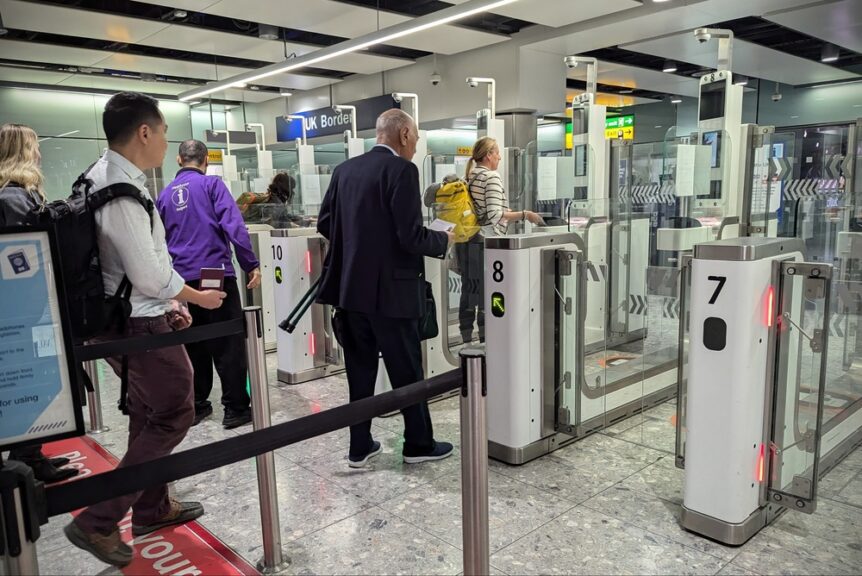
UK business travellers are being told to carry evidence of when they last left the European Union, after a fault in the way departures are recorded left some frequent flyers wrongly close to exhausting the EES 90-day limit.
The Foreign, Commonwealth and Development Office updated its Schengen area travel advice on 11 August 2026 to reflect the problem. British passport holders may spend a maximum of 90 days in any rolling 180-day period across the Schengen area. For firms sending staff on repeated short trips, that allowance disappears faster than most travel policies assume, and the consequences land on the traveller at the border. Refusal of entry is the mildest outcome. In Spain, penalties for less serious infractions start at around 500 euros and rise to a maximum of 10,000 euros.
Where the EES 90-day limit is going wrong
The Entry/Exit System replaced manual passport stamping with an electronic biometric record of each arrival and departure, and completed its rollout in April 2026. The countdown begins when a traveller is registered on entry and should stop when the exit is registered. The difficulty arises when only half of that happens.
Where EES checks are temporarily suspended to clear long departure queues, a fairly common occurrence since the system reached full operation, border officers sometimes revert to a manual passport check instead. Travellers have reported being checked and waved through without a stamp, and without an electronic exit record.
The counter then keeps running after the traveller has landed back in the UK. Some have watched their allowance tick down at home and reach zero. Nothing flags the error, so it surfaces at the next attempt to enter the EU, in front of a queue, rather than as an administrative correction made calmly in advance.
Two sets of official advice, pointing different ways
The FCDO takes a reactive line. Its updated guidance says: “If you believe you have been incorrectly entered into EES or your record of time spent in the Schengen area is incorrect, approach border officials when you next cross the Schengen border and request a correction.”
It adds: “If you are exempt, carry documentation confirming your status. If you believe your time spent in the Schengen area has been recorded incorrectly, raise this with border officials and be prepared to provide supporting evidence if requested.” In practice that means boarding passes and booking confirmations. Some travellers have been asked to produce six months of travel history at the desk.

The European Commission is more preventative. It tells travellers: “You can lodge a complaint with the supervisory authority of the European country using the EES in charge of processing your data”, and publishes an online short-stay calculator so that a disputed count can be identified before departure rather than at arrival.
Asked whether it should bolster its advice to include the day checker, a Foreign Office spokesman said: “EES is an EU system. Decisions relating to entry, exit, the recording of traveller data and the correction of records are matters for the authorities operating the system.”
What travel managers should do now
The gap between the two positions leaves the traveller carrying the risk, which makes this a policy question rather than an individual one. Companies that have already reviewed corporate travel policies for the new border rules should now add a record-keeping step to them.
Boarding passes, e-tickets and booking confirmations for every EU departure are worth retaining for a full 180 days, and ideally six months, whether the expense claim needs them or not. Travellers on frequent short trips should check their remaining days before each booking, not the night before departure, and raise a correction with the relevant national supervisory authority while there is still time to resolve it. The Government’s own EES guidance is the reference point for what is expected at the border.
Booking to the full 90 days now carries an avoidable risk. Treating the allowance as closer to 85 gives a buffer for the days that go missing, and for the officer who has a queue behind you and little appetite for a paperwork dispute.