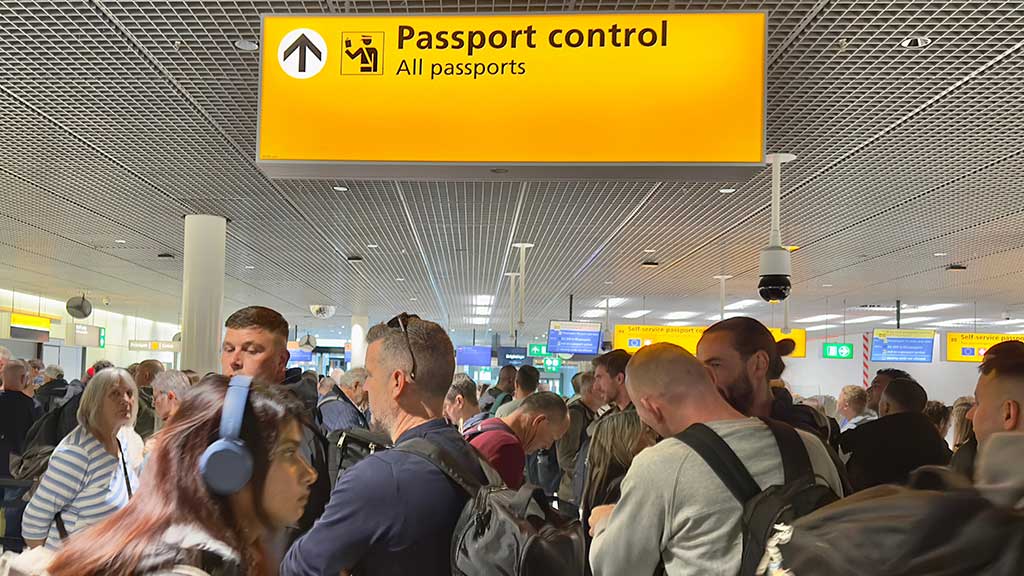
Airlines and UK travel trade bodies are lobbying Brussels to reinstate the flexible arrangements that let border authorities partially suspend EU Entry/Exit System (EES) biometric checks, after the temporary rules lapsed at the start of this week.
For UK business travellers, the outcome will shape how long they spend at Schengen borders over the coming months. The summer flexibilities gave airports and border police the option to switch off fingerprint and facial scanning when queues built up, and both IATA and ABTA argue that removing that safety valve before EES is running smoothly everywhere risks a repeat of the long waits seen earlier this year.
The airline association IATA wants the partial suspension provisions to run until the end of the winter season in late March 2027, a further six months.
Why IATA and ABTA want the EES suspension extended
Thomas Reynaert, IATA’s senior vice president of external affairs, said keeping the ability to suspend EES operations was “absolutely necessary” in the coming months.
“The summer has highlighted where operational challenges remain,” Reynaert said in a LinkedIn post. “Addressing them now means extending the possibility of partial suspension through the winter season, accelerating pre-registration, investing in infrastructure and staffing, and strengthening co-operation between authorities and industry.”
ABTA, the UK travel association, is taking the same position. Luke Petherbridge, its director of public affairs, said the organisation would also press the EU to extend the partial suspension rules. He said the flexibilities had helped to “ease pressures” at airports over the summer, but added that there was “still some way to go until EES is fully and consistently operational across all participating countries”.
The intervention follows a summer in which the EU gave Schengen states room to relax EES checks to keep queues moving, a decision Travelling for Business reported when it was granted in the run-up to the peak season. Before that, the industry had been demanding the power to pause checks after three-hour queues hit some airports.

Brussels says the system worked
The European Commission takes a more upbeat view. A spokesperson told a media briefing last week that EES had “broadly worked well” over the summer, despite industry fears of queue “chaos” at border control during the busiest periods.
“We are in close and constructive contact with those few member states where some adjustments are needed at certain border crossing points,” the spokesperson added.
That gap between the Commission’s assessment and the industry’s experience is the crux of the coming negotiation. Without an extension, member states lose the legal cover to stand down biometric enrolment when queues lengthen, meaning every third-country passport holder must be processed in full regardless of the pressure at the desk.
What UK business travellers should expect
EES collects biometric data, including facial images and fingerprints, from passport holders of third countries, which includes the UK and the US, when they enter any of the 29 Schengen Area members. It was made fully operational in April 2026 after a six-month transition, with the option to partially suspend the system when necessary until 6 September. The UK government’s official EES guidance explains what British passport holders should expect at the border, and the EU’s own travel-europe EES pages set out the rules from the Schengen side.
The practical advice for frequent flyers to Europe is unchanged for now: build extra time into arrivals for the first trip after any break, because first-time enrolment takes longest, and watch for any Commission decision on the winter flexibilities before the October half-term and pre-Christmas travel peaks. Travellers who have already registered once should find subsequent crossings quicker, though consistency still varies by country and crossing point.
Looking further ahead, EES is due to be followed by the European Travel Information and Authorisation System (ETIAS), the EU’s answer to the long-established US ESTA and the UK’s newer ETA scheme. Once live, third-country passport holders will need to apply for an ETIAS, currently expected to cost €20, before travelling to a Schengen country. Our earlier report on the ETIAS fee rising to €20 sets out what that means for UK travellers. The EU had intended to launch ETIAS in the final quarter of 2026, but a slip into 2027 now looks increasingly likely, giving corporate travel managers a little longer to prepare policies and budgets.