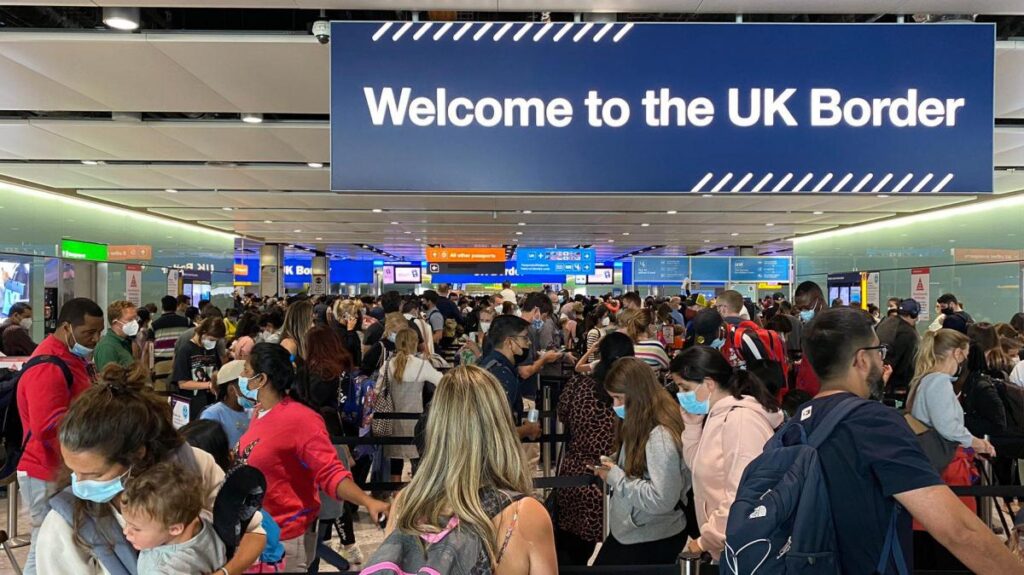
Business travellers are being warned to brace for severe disruption across Europe’s busiest hubs after the rollout of the EU’s long-delayed Entry-Exit System (EES) triggered queues of up to three hours at passport control, with the airports lobby now demanding emergency powers to switch the checks off when terminals seize up.
Airports Council International (ACI) Europe, the trade body representing more than 600 airports across the continent, has confirmed that passengers passing through gateways in France, Germany, Belgium, Italy, Spain and Greece have been held at border desks for several hours since the biometric regime went fully live on Friday.
Olivier Jankovec, director general of ACI Europe, warned that the situation will become untenable once the summer peak arrives. He told the Financial Times that current queueing times, recorded while traffic is only beginning to build, would be “simply unmanageable” in the coming weeks. Jankovec said the organisation wants the authority to “fully suspend EES registration” whenever waiting times at border control become excessive.
The system, which requires non-EU nationals, including UK passport holders, to register fingerprints, facial scans and personal data on first entry, now applies across the 25 Schengen EU states plus Iceland, Liechtenstein, Norway and Switzerland. It has been phased in since October but only moved to full operation on 10 April.
Early evidence of strain emerged at the weekend when the BBC reported that more than 100 passengers were left behind at Milan as an easyJet service to Manchester departed without them, after passport desks failed to clear the queue in time.
ACI representatives met European Commission officials on Tuesday to thrash out the escalating problems. According to the FT, the industry group is pressing Brussels to extend existing exemptions and grant airports the discretion to pause registration entirely at pinch points.

The Commission, however, struck a more upbeat tone. A spokesperson insisted that the rollout was “working very well” in the overwhelming majority of member states, putting the average processing time for a passenger at 70 seconds. ACI disputes that figure, saying registration can stretch to five minutes per traveller. The Commission conceded that “a few member states” had encountered technical faults, which it said were being resolved, and stressed that operational delivery was a matter for national authorities.
In the days before full launch, cross-Channel travellers heading from the UK to France were spared biometric capture altogether after Paris admitted its systems were not ready to collect and process the data in time for the Easter getaway.
The border squeeze is landing at a sensitive moment for European aviation. ACI has separately written to the EU’s energy and transport commissioners warning that the bloc is barely three weeks away from systemic jet fuel shortages following the blockade of the Strait of Hormuz. Europe burned roughly 1.6 million barrels of jet fuel a day last year, according to the International Energy Agency, with about 500,000 imported and some three-quarters of those imports originating in the Middle East.
Ryanair chief executive Michael O’Leary, never one to mince his words, branded the new regime “a shit show and a shambles” and a “punishment for Brexit”, claiming queues at some airports had already stretched to four hours. He urged Brussels to delay full implementation until October.
For corporate travel buyers, the message is stark: build substantial buffers into itineraries on European routings, brief travellers on what to expect at the kerb, and watch closely as Brussels decides whether to hand airports the kill switch before the summer rush begins in earnest.