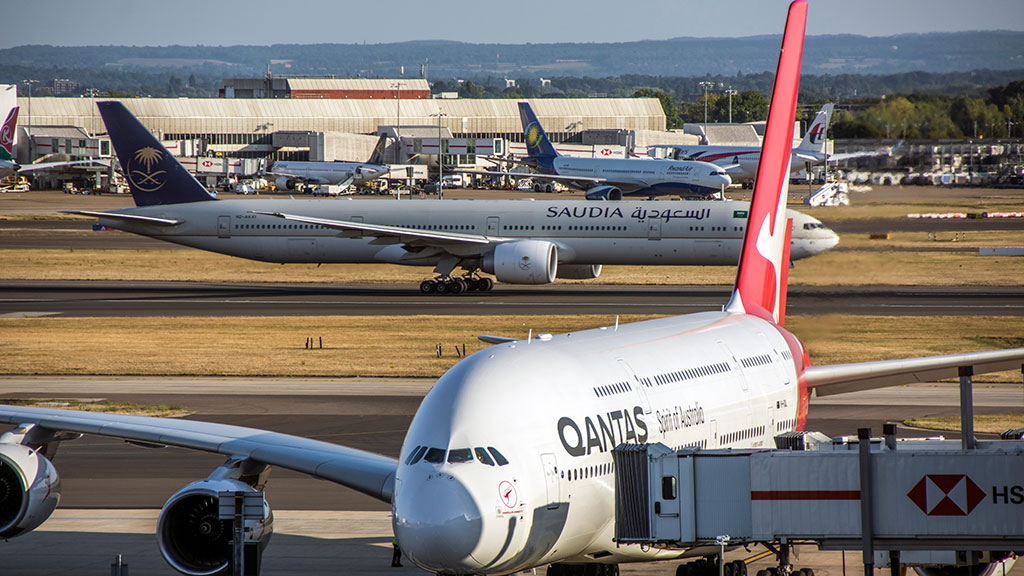
Qantas has been crowned the world’s most punctual major airline for June, completing a remarkable recovery for a carrier that ranked 106th globally for punctuality just three years ago.
For UK business travellers heading to Australia on the Kangaroo Route, the finding offers reassurance that one of the longest journeys in corporate travel is now among the most reliable. According to aviation data provider OAG, Qantas recorded an on-time performance of 87.16 per cent across 22,617 flights, narrowly beating Colombia’s Avianca (87 per cent) and India’s IndiGo (86.64 per cent) among airlines operating more than 20,000 flights a month. SAS Scandinavian Airlines (83.65 per cent) and Pegasus Airlines (83.1 per cent) completed the top five.
From 106th to first in three years
The June result was no fluke. Qantas has finished in OAG’s global top three in five of the past six months, missing out only in March when Tropical Cyclone Narelle disrupted services.
Domestically, almost 85 per cent of Qantas flights departed on time in June, the airline’s best result for the month since 2017. On international services, 74 per cent of flights departed on schedule and more than 87 per cent arrived within 30 minutes of their scheduled time.
The turnaround is striking given where the airline started. In the early 2020s, staff shortages, grounded aircraft, airport congestion and a post-pandemic surge in demand combined to damage Qantas’s reputation, at a time when airfares were also climbing. The contrast with conditions closer to home is notable too, with Gatwick recently named the UK’s worst airport for delays for a second consecutive year.
Technology and fleet renewal behind the recovery
Vanessa Hudson took over as Qantas Group chief executive in September 2023, stepping into the role two months earlier than planned after the abrupt departure of her predecessor, Alan Joyce. Her focus since has been operational reliability rather than dramatic public repositioning.

The airline introduced artificial intelligence tools to sharpen daily operational planning and forecasting, overhauled aircraft turnaround procedures, tightened crew and aircraft allocation, and began boarding some aircraft through two doors to cut time on the ground.
Newer aircraft have also helped. The Airbus A321XLR, which entered commercial service with Qantas as part of the carrier’s largest-ever fleet renewal programme, and the Airbus A220-300 have progressively replaced older Boeing 737-800s and 717s on domestic and regional routes. The multi-billion-dollar renewal spans more than 200 aircraft on firm order.
Rising costs will test the ranking
The punctuality gains have come during a financially demanding stretch, even after the group posted a strong first-half profit supported by sustained travel demand.
Higher jet fuel costs linked to the conflict in the Middle East are expected to add up to AU$800 million (approximately US$520 million) to the airline’s fuel bill in the second half of the 2026 financial year, taking total second-half fuel costs to between AU$3.1 billion and AU$3.3 billion (US$2 billion to US$2.15 billion approximately).
Longer routings around restricted airspace have added further strain to international operations, and Qantas has already trimmed domestic capacity and raised fares in response. For business travellers, that may mean paying more for the reliability the airline has worked so hard to restore. Sustaining a number one ranking through rising costs and network disruption will be a tougher test than reaching it.