


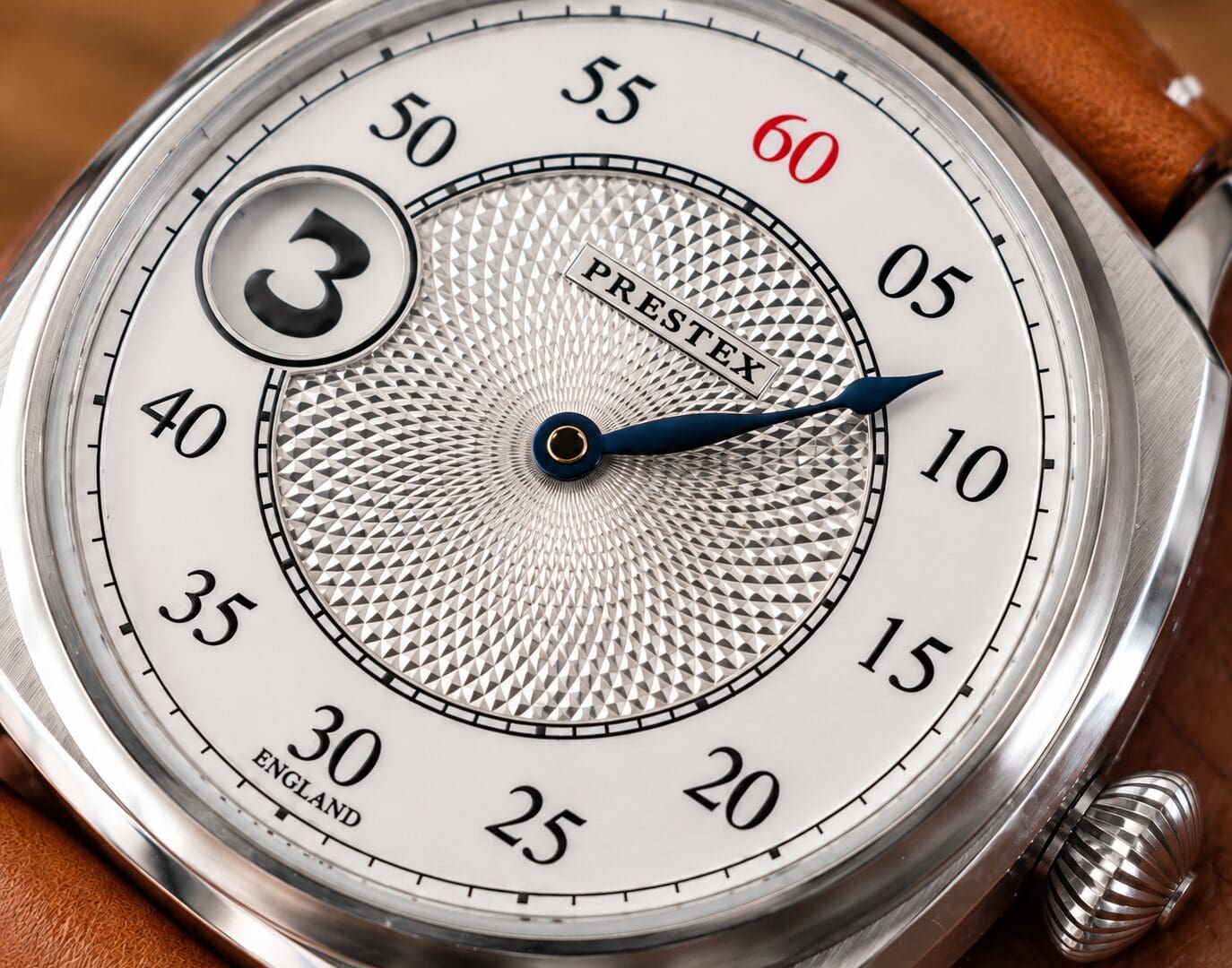
Prestex’s new Marcato arrives with the kind of quiet confidence only a well‑executed mechanical complication can justify — and after spending time with it, that confidence feels earned.
Announced earlier this year as a fresh take on one of watchmaking’s most charming quirks, the jumping hour, the Marcato has now landed as a finished, working piece that you can finally pick up, strap on and experience in motion.
First Impressions
Prestex calls it “a big moment when a new watch finally arrives,” and they’re right: drawings and prototypes can only take you so far. The Marcato feels more refined in the metal than its early visuals suggested — slim, balanced and immediately distinctive thanks to its unconventional hour aperture placement at 9 o’clock. It’s a small design decision that makes a big difference. At 12, the minute hand can obscure the jump; at 3, it risks looking like a date window. At 9, it reads cleanly, naturally, and with a pleasing left‑to‑right logic: hour, then minutes.
The Jumping Hour, Reimagined
The complication itself is a delight. Instead of an hour hand sweeping around the dial, the Marcato displays the hour digitally, snapping to the next numeral the moment the minute hand hits 60. It’s a tiny piece of mechanical theatre precise, immediate and oddly satisfying to watch, especially knowing it happens 24 times a day whether you’re paying attention or not.
Prestex’s twist is not just aesthetic. Inside sits the Swiss-made Sellita SW300, chosen deliberately over the more common SW200 for its refinement, longer power reserve and crucially, its slimmer profile — about one millimetre thinner, which matters when you’re accommodating a jumping-hour module without creating a bulky case.
Design Notes & Naming
The name “Marcato” comes from musical notation, meaning “marked” or “accented” — a nod from brand owner Neil Duckworth, himself a musician, to the emphatic snap of the hour change. It’s a thoughtful touch, and one that gives the watch a sense of personality beyond its mechanics.
Aesthetically, the Marcato feels like Prestex at its best: vintage British cues, contemporary proportions and a clear respect for the brand’s heritage, revived from the original Prestex company founded in the 1920s by Duckworth’s grandfather.
Value & Variations
Perhaps the most striking part of the Marcato story is the price. Jumping-hour watches are rare, mechanically complex and usually expensive. Prestex has managed to deliver the complication, the higher-spec SW300 movement and a bespoke module for £1,950 — a figure that feels almost mischievous given what’s inside the case.
Production is limited to 300 pieces across four dial variations, with 75 individually numbered examples of each — enough to feel special without drifting into inaccessible territory.
The Prestex Marcato is a clever, characterful watch that punches well above its price point. The jumping hour is executed with charm and precision; the movement choice is thoughtful; the design is distinctive without being eccentric. It’s the kind of watch that feels genuinely different on the wrist — not because it’s trying too hard, but because every decision has been made with purpose.
For enthusiasts who want a mechanical complication with personality (and without the usual eye-watering cost), the Marcato is a standout arrival.
How we review
Travelling for Business pays for the rooms, flights and products we review unless we explicitly say otherwise. We never accept paid reviews or gifted stays in exchange for coverage.

