

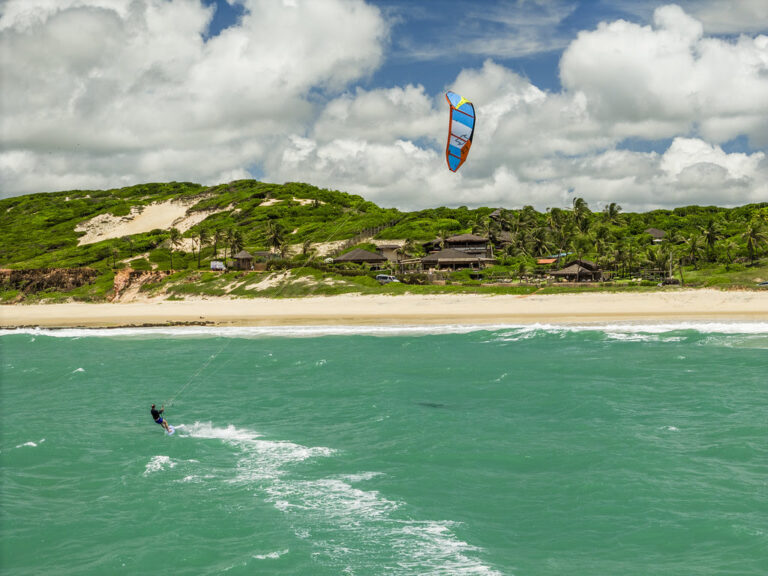
Brazilian athletes hold prominent positions on the international stage, while over seven thousand kilometres of coastline offer diverse experiences for those wishing to explore the country by following the wind
Brazil’s prominence in international kitesurfing stems from more than just its beaches and natural conditions; the country is also represented among the sport’s top names across various disciplines. According to the GKA Kite World Tour Rankings, in the men’s Kite-Surf category, Gabriel Benetton holds second place, while Sebastian Ribeiro ranks sixth. Among the women, Bruna Kajiya, Kesiane Rodrigues, Serena Luz, and Luiza Neto share eighth place.
Brazil’s leading role extends to other categories as well. Mikaili Sol tops the rankings in women’s Big Air, while Bruna Kajiya holds the number one spot in women’s Freestyle. Among the men, Davi Ribeiro ranks third in Freestyle, and Josué San Ferreira sits in sixth place in Big Air.
These results highlight a connection that goes far beyond competition. With a coastline stretching over seven thousand kilometres and a wide variety of wind patterns, temperatures, and landscapes, Brazil offers destinations that attract both professional athletes and travellers eager to try wind-based sports.
From Ceará in the Northeast—where steady winds have turned spots like Cumbuco and Taíba into gathering places for enthusiasts from around the globe—to the lagoons and subtropical waters of Santa Catarina, one can traverse the country following the wind. Along the way, travellers discover dunes, mangroves, tropical forests, fishing villages, regional cuisine, and diverse coastal cultures.
It is within this landscape that Brazilian athletes find the ideal conditions to train and deepen their connection to the sport. And it is this same Brazil that welcomes travellers—whether they want to ride the waves, learn to get up on a board, or simply explore destinations where the wind is an integral part of both the scenery and local life.
Cumbuco, Ceará: where the wind is part of the daily routine
Located about 35 kilometres from Fortaleza, the capital of Ceará, Cumbuco is one of Brazil’s premier kitesurfing destinations. A combination of warm waters, vast stretches of sand, and steady winds has helped transform this former fishing village into an international hub for the sport. Throughout the day, colourful kites fill the horizon, while specialised schools and facilities cater to everyone from first-timers to professional athletes. Off the water, the experience continues at beachfront kiosks and restaurants, where fish and seafood feature prominently in a cuisine shaped by the local communities’ historic connection to the ocean.
Taíba, Ceará: from lagoon to ocean
Continuing along the Ceará coast, Taíba combines two vastly different environments just minutes apart. The calmer waters of its lagoons offer ideal conditions for beginners and activities like stand-up paddleboarding, while the open sea attracts enthusiasts seeking waves and a more intense experience. This ability to switch between different conditions in a single destination is one of the features that has made the region popular among wind-sport enthusiasts.
Atins, Maranhão: kitesurfing amidst the dunes of Lençóis Maranhenses
Further north, the small village of Atins lies within the Lençóis Maranhenses region, a UNESCO World Natural Heritage site. Here, the scenery shifts dramatically. White sand dunes meet freshwater lagoons formed by rainfall, while mangrove forests mark the transition between rivers and the ocean. During the day, the winds draw kitesurfers from all over the world. Off the water, the village retains the atmosphere of a small coastal community, featuring fishermen, intimate inns, and restaurants that incorporate local ingredients and traditions. The blend of sport and one of Brazil’s most unique natural landscapes makes Atins one of the most distinctive experiences on this route.
São Miguel do Gostoso, Rio Grande do Norte: sports and village life
In Rio Grande do Norte, São Miguel do Gostoso is another well-established destination for wind sports enthusiasts. This former fishing village retains its sandy streets and laid-back atmosphere, while open beaches benefit from winds ideal for activities like kitesurfing and windsurfing. Once the boards are put away, the pace of the experience shifts. Restaurants, small bars, and inns coexist with the local community’s daily life, and Tourinhos Beach—renowned for its rock formations and sunsets—is one of the region’s most iconic spots.
From the Southeast to the South: different landscapes, new winds
While the Northeast is home to some of Brazil’s most internationally renowned wind sports destinations, travelling down the coast toward the South reveals completely different landscapes and conditions. Tropical forest, islands, coastal lagoons and lower temperature waters become part of the route.
Ilhabela, São Paulo: sailing and Atlantic Forest
On the coast of São Paulo, Ilhabela combines tradition in water sports with an extensive preserved area of Atlantic Forest. The winds that cross the channel between the island and the mainland have made the archipelago one of the country’s main sailing destinations. For visitors, this means being able to combine activities at sea with trails, waterfalls and beaches surrounded by tropical forests.
Caiçara culture, historically linked to fishing communities on the coast of Southeastern Brazil, also appears in gastronomy, with fish, seafood, plantains and other regional ingredients. It is a very different experience from the northeastern coast and an example of the diversity found when following the Brazilian coast.
Araruama Lagoon, Rio de Janeiro: wind between salt flats and tradition
In the Lakes Region, in the state of Rio de Janeiro, Araruama Lagoon brings together natural conditions that attract kitesurfers and windsurfers. In addition to water sports, the landscape holds a history directly linked to salt. Traditional salt pans remain part of the scenery and help tell how the lagoon shaped the economy and culture of the region’s communities over generations. It is precisely this combination that differentiates many Brazilian destinations: sport works as a starting point, but quickly leads the visitor to other experiences linked to local history and culture.
Ibiraquera Lagoon, Santa Catarina: between lagoon, ocean and whales
In the south of Brazil, the Ibiraquera Lagoon, in Santa Catarina, presents another scenario. Calmer waters in the lagoon allow for practicing and learning water sports, while the nearby ocean offers different conditions for more experienced participants. The region also maintains a strong connection with artisanal mullet fishing, a tradition that mobilises coastal communities in Santa Catarina. And there is another visitor that transforms the landscape in certain months of the year: the southern right whale. During their breeding season on the coast of Santa Catarina, these animals can be observed at different points along the coast, adding a natural experience to the trip.
A trip through Brazil guided by the wind
For travellers interested in water sports, the wind can act as a kind of alternative map of Brazil. Following it means leaving the warm waters and dunes of the Northeast, crossing landscapes of the Atlantic Forest in the Southeast and reaching the lagoons and the coast with a subtropical climate in the South. At each stop, the conditions for practising sports change, but also the food, the landscape, the accent and the culture. It is possible to start with windy days in Cumbuco, head to the dunes and lagoons of Lençóis Maranhenses, exchange the tropical scenery for the Atlantic Forest of Ilhabela and end the trip in the waters of Santa Catarina.
Schools and specialised operators allow many of these destinations to be enjoyed by those who have never stood on a board. For the more experienced, geographic diversity offers the possibility of seeking different winds and conditions without leaving the country.

