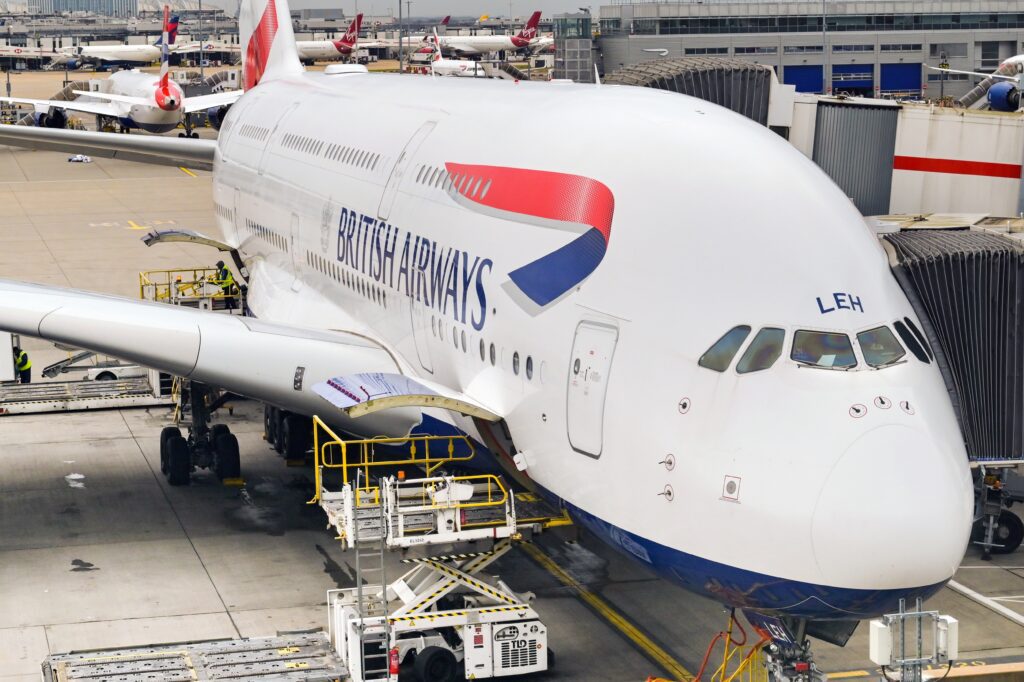
British Airways is to gut its Middle East network in a sweeping retreat that threatens to upend the carefully choreographed itineraries of thousands of corporate flyers who depend on the Gulf corridor.
The flag carrier will terminate its London to Jeddah service outright from 24 April, bringing the curtain down on one of its longest-standing routes into Saudi Arabia. Riyadh, meanwhile, will be halved to a single daily rotation when services resume in mid-May, trimming what was until recently a twice-daily operation.
The pruning does not end there. Dubai, Doha and Tel Aviv are pencilled in to return from 1 July, but at a dramatically reduced cadence. Dubai, for decades a workhorse of BA’s long-haul commercial schedule, will drop from three daily flights to just one. Doha and Tel Aviv will each fall from two daily services to one.
For the frequent business traveller, the implications are immediate and unwelcome. Reduced frequencies translate directly into reduced flexibility, and flexibility is the currency on which corporate travel trades. The early-morning departure, the same-day return, the ability to recut a meeting schedule around a late-running deal, all become appreciably harder when the schedule thins.

British Airways has attributed the recalibration to persistent regional instability and a desire to offer customers greater certainty over what it can reliably operate. In practice, however, the move is as much about redeployment as retreat. Aircraft and crews are being shifted to routes where demand is running hot, with the airline lining up expanded summer services to Bangalore, Mumbai, Delhi, Hyderabad and Nairobi — a clear pivot towards the Indian subcontinent and East Africa.
That pivot will be of cold comfort to travel managers whose programmes lean heavily on the Gulf. Many will now be forced to divert corporate volumes to Middle Eastern carriers, yet several of those airlines are themselves still operating below pre-war capacity and continue to navigate their own operational constraints.
The net effect is a more brittle travel market on one of the UK’s most commercially important corridors. For the companies whose executives fly the Gulf on a near-weekly basis, the coming months will demand sharper planning, earlier booking windows and, in some cases, a wholesale rethink of preferred carriers and routings. BA’s recalibration may make operational sense in the boardroom at Waterside; on the road, it reads as one more headache for a business travel sector already short on slack.