


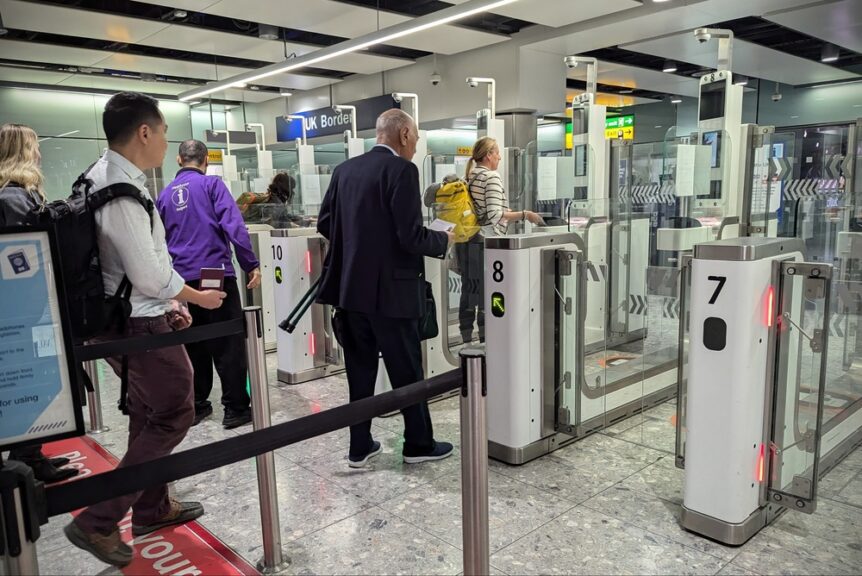
Contactless eGates at UK airports have moved from trial to reality, with East Midlands Airport becoming the first in the country to let arriving passengers through the border without presenting a physical passport.
The Home Office announced the change on 6 October 2026, confirming that the system will be extended in phases to every major airport, with the national rollout due to be complete by early 2027. For frequent flyers who land late and want to be on the road or the train quickly, the headline figure is speed: government testing shows the new process is up to 25% faster than the passport-based gates in use today.
How the passport-free gates work
The traveller walks up to the gate, a camera captures an image and the system checks it against official passport and immigration records held on government databases. Once the match is confirmed the gate opens automatically, with no need to place a passport on the reader.
It is not a licence to leave documents at home. The Home Office has stressed that travellers must continue to carry their passports at all times, and anyone selected for additional checks may still be asked to scan the document or speak to a Border Force officer. According to the Home Office announcement on contactless airports, the East Midlands launch is initially open to British citizens, with other nationalities already eligible for eGates to follow.
Phil Douglas, Director General of Border Force, called the upgrade “a win for travellers”, saying the technology will make journeys “smoother and faster” while maintaining robust border security. He added that the digital programme builds on recent changes allowing children aged eight and above to use eGates, easing family travel during busy periods.
When will eGates go contactless?
Every airport that currently has eGates is expected to switch to the new system by 2027, although the announcement does not give individual switch-on dates beyond East Midlands. The gates are in place at Birmingham, Bristol, Cardiff, East Midlands, Edinburgh, Gatwick, Glasgow, Heathrow, London City, Luton, Manchester, Newcastle and Stansted.

East Midlands went first this week. Steve Griffiths, managing director of East Midlands Airport, said the airport was “delighted” to be the first to adopt the technology, adding that it complements recent improvements made to the immigration hall to improve passenger flow. The airport publishes its own advice on passport control at East Midlands, and our East Midlands airport guide covers onward transport once you are through the border.
Karen Dee, chief executive of Airports UK, described the development as “excellent news for the passenger”, noting that fast, efficient borders are now an essential expectation for arrivals into the UK.
What contactless eGates at UK airports mean for business travel
The idea has been a long time coming. Travelling for Business reported in January 2024 on Border Force plans for facial recognition to replace passport checks. What has changed this week is that facial recognition eGates are now processing real passengers rather than sitting in a strategy document.
A quarter off processing time matters most at peak arrival times, when several flights land close together and queues build in the immigration hall. For companies, that has a bearing on how tightly ground transport, rail connections and same-day meetings can be scheduled after a flight. The gain will be felt most at the biggest hubs, and our Heathrow airport guide sets out what to expect there in the meantime.
Three practical points follow for employers and travel bookers. First, staff should keep their passport to hand on arrival, because the reader remains the fallback whenever the camera check is not enough. Second, the rollout is phased, so the experience at one airport this autumn will not necessarily match another. Third, eligibility at launch is narrower than for the existing gates, which means colleagues travelling together on different passports may be processed differently for now.
Until contactless eGates at UK airports are universal, the sensible approach is to treat any time saved as a bonus rather than build it into the itinerary. Travel policies and arrival buffers can be revisited once the upgrade reaches the airports a business uses most.

