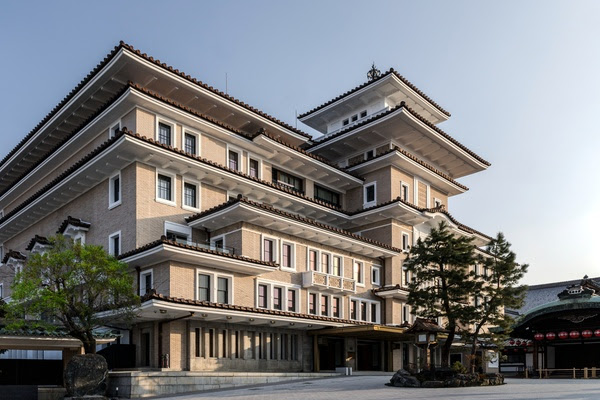
The Imperial Hotel, Kyoto has passed a significant heritage milestone after Japan’s Council for Cultural Affairs confirmed that the 1936 Yasaka Kaikan building at the heart of the property will retain its status as a Registered Tangible Cultural Property, now listed under the new designation “Former Yasaka Kaikan”.
For UK business travellers weighing up where to stay in Japan’s cultural capital, the ruling matters. It confirms that one of the newest luxury addresses in Kyoto’s Gion district is also one of its most carefully protected, giving corporate guests the rare option of basing themselves inside a nationally recognised landmark rather than simply near one.
The 55-room hotel opened in March 2026 and joined The Leading Hotels of the World in April 2025, placing it within a portfolio familiar to travel managers booking high-end programmes across Europe and Asia. It is Imperial Hotel’s fourth property, sitting alongside its established addresses in Tokyo, Osaka and Kamikochi, and arrives as Kyoto sees a wave of luxury debuts, including Capella’s first Japanese property in the nearby Miyagawa-cho district.
Restoration over demolition
The Yasaka Kaikan had faced mounting problems from age, deterioration and seismic risk, and demolition was a realistic prospect. Imperial Hotel instead chose adaptive reuse, preserving key architectural elements of the 1936 structure and integrating them into the hotel’s design.
“From the beginning, our goal was to honour the architectural and cultural significance of the Yasaka Kaikan while ensuring its relevance for generations to come,” said Reiko Sakata, General Manager of the Imperial Hotel, Kyoto. “The continuation of its cultural property registration recognizes not only the building’s history, but also the importance of preserving meaningful places through thoughtful restoration and reuse.”

The most visible achievement is the conservation of the building’s southwestern facade, long regarded as a defining feature of Kyoto’s historic streetscape. Original exterior tiles and terra-cotta ornamentation were conserved and reinstalled, portions of the original structural framework were retained, and the distinctive copper roof and decorative metalwork were reconstructed using traditional techniques.
More than 16,000 tiles saved by hand
The scale of the work is striking. More than 16,000 original exterior tiles were removed and refitted using ikedori, a traditional Japanese conservation technique that allows historic materials to be salvaged and reused without damage. Craftsmen also restored the building’s decorative terra-cotta reliefs, which feature traditional floral motifs, and conserved historic interior details in the entrance vestibule, including original etched glass dating to the building’s construction.
Completed in 1936 next to the Gion Kobu Kaburenjo, the Yasaka Kaikan served generations of Kyoto residents as a theatre, cinema, dance hall and gathering place, blending traditional Japanese design with early twentieth-century construction methods.
What it means for visiting executives
Kyoto remains a fixture on UK corporate itineraries, whether for meetings with the region’s manufacturing and technology firms or as the cultural leg of a longer Japan programme. The city’s shortage of genuinely distinctive luxury inventory has been easing, a trend explored in our look at the luxury hotel openings set to reshape business travel in 2026, and the Imperial Hotel, Kyoto adds a heritage dimension few rivals can match.
For those building a wider itinerary, the group’s approach to pacing a Japan trip is worth noting, with its Kamikochi retreat positioned as a counterweight to time in Tokyo, Osaka and Kyoto. Guests staying at the Gion property are, in effect, contributing to the continued stewardship of a protected building, a point that may resonate with companies whose travel policies increasingly weigh sustainability and cultural impact alongside price and location.