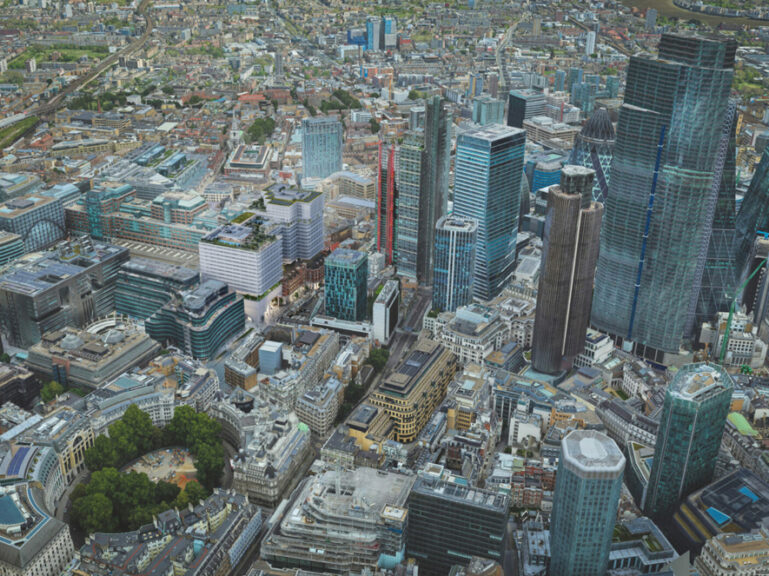
The company behind a consented 46-storey tower beside Broadgate is examining whether the building should become a Liverpool Street hotel from top to bottom. Maya Capital, the London investor that paid around £60m for Bavaria House at 13 to 14 Appold Street, is testing a version of the scheme that would remove the office floors included in the original permission.
The location explains why the answer matters to anyone booking corporate travel. Appold Street sits on the City fringe between Broadgate and Liverpool Street, which the Office of Rail and Road has ranked as Britain’s busiest railway station for three years running after it recorded 98 million entries and exits in the year to March 2025. The Elizabeth line runs beneath it, the surrounding towers hold the Square Mile’s heaviest concentration of corporate offices, and the hotel market serving them clusters at the upper mid-market level.
What the Bavaria House consent allows
Hackney’s planning sub-committee backed the scheme in September 2015 and formal permission followed in March 2016. The Greater London Authority’s report on the application describes a 46-storey building rising to 156 metres, with a 392-room hotel sitting above 11,270 square metres of offices.
The mix had already shifted by the time the site last changed hands. Marketing material issued in 2024 put the building at 340,085 square feet in total, with a 416-key hotel spread across 26 upper floors and 88,286 square feet of office space below.

Stripping the offices out entirely would lift the room count again, although no revised total has been published and neither has a height for any reworked design. Converting the whole tower to hotel use would also mean returning to the council for a new consent, and that process has not begun.
A bigger Liverpool Street hotel
The ownership trail shows how the thinking has moved. Masterworks Development Corporation, the New York firm behind the Club Quarters brand, sold Bavaria House in 2021. Its buyer, the Chinese-backed Giant Mind Properties, appointed Savills and CBRE in October 2024 to invite offers above £75m, and Maya Capital completed its purchase at around £60m.
Budget brand Motel One has been named as the likely operator of the finished hotel, although no party involved has confirmed it. Whoever ends up running the building, the commercial logic points one way. Recent arrivals in and around the City have courted the four and five star traveller, from the Westin London City by the river to Dalata’s Clayton Hotel on Old Broad Street, and a tall tower of simpler, cheaper rooms would give the district something it currently lacks.
What it would mean for travel budgets
For travel managers the practical question is price and volume. Several hundred extra keys at a sharper nightly rate, within walking distance of Broadgate and a short lift ride from the Elizabeth line, would widen choice in exactly the postcode where corporate demand runs strongest. For SMEs whose policies cap London nights, the gap between an upper mid-market rate and a true budget rate can decide whether a team stays over or squeezes the trip into a single day. With London tourist taxes also under debate, downward pressure on room costs is in short supply, and fresh competition is one of the few forces that reliably delivers it.
None of this will change bookings soon. A full planning application has yet to be submitted, and a tower on this scale takes years to design, approve and deliver once it has. The signal still counts, though. An investor sitting on one of the best-connected corners of the capital has run the numbers and backed beds over desks.