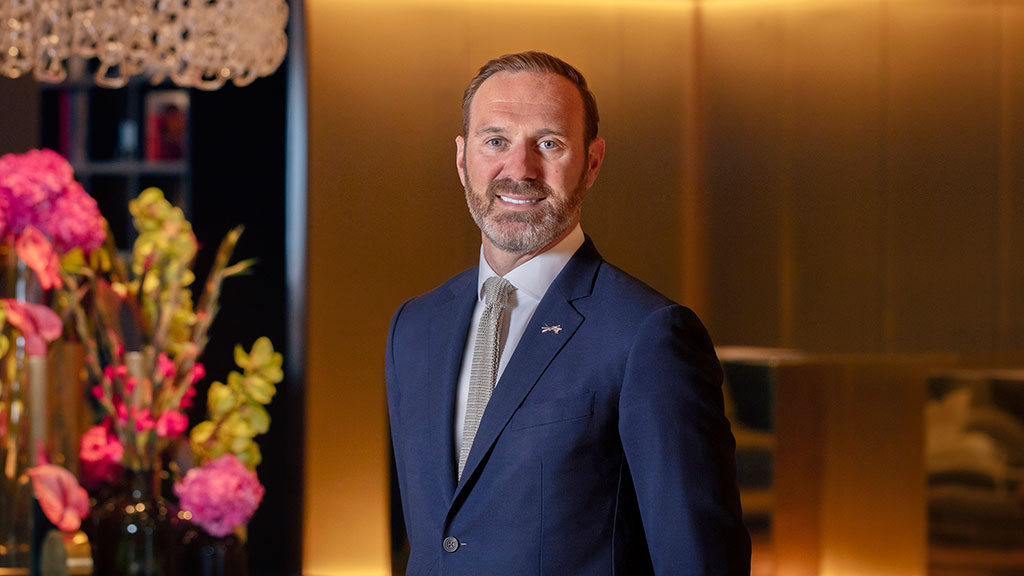
Every general manager has an origin story, and most of them begin, as tradition demands, at the pot wash. Eugene Leonard’s does too. But the more revealing scene comes earlier, in an Irish family home in the 1980s, where a small boy is sorting through the spoils of his father’s latest business trip: headed notepaper, luggage tags, the small branded treasures that airlines and grand hotels once scattered like confetti.
“My father travelled extensively for business during the 1980s, and as a child it all seemed incredibly glamorous,” Leonard tells me. “He would come home with hotel stationery, luggage tags and little gifts from places around the world, and I became fascinated by travel and hotels long before I really understood the industry.”
It is a fitting creation myth for a man now sitting in one of the most storied addresses in world hospitality. Leonard is general manager of Hotel Café Royal, the 159-room grande dame at 68 Regent Street where Oscar Wilde held court in the 1890s, the Queensberry Rules of boxing were drawn up, and David Bowie threw the 1973 party at which Ziggy Stardust was retired. For a business travel readership, the symmetry is irresistible: the corporate traveller’s souvenirs lit a fuse that ended, four decades later, in the corner office of one of London’s great hotels.
From the pot wash to Shannon
The glamour of the luggage tags met reality soon enough, and the reality took. “I fell in love with hospitality very young. I started washing pots in a hotel and immediately loved the energy of it, the people, the pace, and that sense that no two days were ever quite the same,” he says. “I’m Irish, and I think there’s something in our nature that encourages us to travel, explore and find our place in the world.”
The formal grounding came at Shannon College of Hotel Management, the Irish institution founded in 1951 beside the airport that invented duty free, and now part of the University of Galway. Its alumni run luxury properties on every continent, and Leonard credits it without hesitation. “It gave me an extraordinary grounding in the industry and prepared me incredibly well for an international career,” he says. Shannon graduates are famous for turning up everywhere; Leonard’s own route out of Ireland ran through Scotland and Zurich, with a spell at Mandarin Oriental Hyde Park, before he arrived at the group that would define him.
The Maybourne years
“The lion’s share of my career was spent with Maybourne, working across some of London’s most iconic hotels,” he says, with the studied understatement of a man who spent a decade and a half inside Claridge’s and The Connaught, ultimately as hotel manager of both. These are the properties against which London luxury is calibrated, as we found when we checked in to Claridge’s for our own review, and Leonard’s years there coincided with a period when the group threw open its doors to the cameras.
“I was fortunate to be involved in major renovation projects, appear in BBC documentaries about life behind the scenes in luxury hotels, meet the late Queen, and eventually move to Los Angeles to help open the group’s first international hotel in Beverly Hills,” he says. He delivers the list evenly, as though renovating national treasures, prime-time television and an audience with Queen Elizabeth II were standard entries on a hotelier’s CV. When BBC Two’s fly-on-the-wall series Inside Claridge’s aired in 2012, millions of viewers got their first honest look at the machinery beneath the polish of a great hotel; the man now running Café Royal spent his formative years inside precisely that machinery.
The Los Angeles chapter deserves pausing on. When Maybourne planted its flag in California, taking on the former Montage and relaunching it as The Maybourne Beverly Hills, it was the group’s first property outside the capital, and the stakes were considerable. Leonard ran it for three years, and the experience left a mark that had little to do with occupancy figures. “California also gave me a different perspective on hospitality, particularly around culture, creativity and looking after your people,” he says. The property he helped establish has become a fixture of the West Coast luxury circuit, as this magazine found when we visited The Maybourne Beverly Hills and discovered a hotel where art and hospitality genuinely converge.
In August 2024 the call came from Regent Street, and Leonard came home, or at least to the city that had made him. “Today, I’m general manager of Hotel Café Royal, one of London’s great hotels,” he says. “I’m enormously excited about what we’re building here.”
The business of making people happy
Ask Leonard what has kept him in the industry for the best part of four decades and the answer arrives without a beat of hesitation.
“Hotels are extraordinary places because everything happens within them. People arrive from all over the world for business, celebrations, romance, family occasions and sometimes the biggest moments of their lives,” he says. “That still excites me today. I often tell our colleagues that we’re in the business of making people happy. There aren’t many careers where you get the opportunity to do that every single day.”
It would read as a greeting-card sentiment from a lesser operator. From Leonard it functions as an operating principle, and it shapes his answer to the question every luxury hotelier is currently wrestling with: how to keep pace with trends without being dragged around by them.
“For me, they’re almost the same thing,” he says of trends and changing guest preferences. “The most important trends are usually emerging because guest behaviour is changing, so our job is to listen carefully enough to recognise that change early.”
The listening has produced a subtle but significant shift in how Café Royal sells itself. “We’re increasingly marketing around why people are travelling rather than simply what our hotel offers. Guests might be coming to London for Wimbledon, Frieze, fashion, theatre, a concert, a family weekend or simply to experience the city. The hotel needs to become part of that reason for travelling.”
That is an interesting inversion, and one the wider industry is only beginning to grasp. The hotel as noun, a pile of rooms and restaurants, gives way to the hotel as part of the sentence the traveller is already writing. For travel managers and frequent flyers the read-across is obvious: a property that organises itself around the purpose of a trip, rather than the mere fact of one, is a property that will fold a client dinner, a theatre curtain or a partner’s weekend into the itinerary without friction, which is increasingly where corporate loyalty is won. Beyond that, he reels off the demand lines he is watching: “experiences, performance focused wellness, family travel, cultural connection and genuine personalisation.” On technology, he draws a line that corporate travellers, weary of app-only service, will cheer. “I don’t believe technology should ever replace hospitality. It should remove friction and administration, giving our colleagues more time to engage with guests.”
And the discipline that holds it all together? “The challenge is knowing which trends have longevity. You don’t chase everything. You understand your guest, remain curious, and evolve in a way that still feels authentic to your hotel.”
Walking the floors
Leonard’s management style was formed in hotels where the general manager is a visible, almost theatrical presence, and he has no intention of retreating behind a dashboard.
“I like being present in the hotel. You learn far more walking the floors, speaking to colleagues and guests, and experiencing the operation yourself than you ever will sitting behind a desk looking at a report,” he says. “I’m demanding about standards because our guests should expect exceptional experiences, but leadership also means creating the environment in which people can deliver them.”
The Californian lesson resurfaces here, distilled to a sentence he repeats like a creed: “Look after your people and they’ll look after you.”
At Café Royal the philosophy is embedded in the vocabulary itself. “We deliberately use the word colleague at Café Royal because nobody is more important than anybody else. We simply have different responsibilities,” he says. “When people feel respected, supported and trusted, extraordinary hospitality tends to follow.”
The next chapter of a 160-year story
The strategic picture Leonard inherits is an unusual one. Café Royal is neither a chain hotel nor entirely alone in the world. It is a standalone property, owned by the Alrov Group and affiliated to The Set and Leonard regards that structure as the best of both worlds.
“As a standalone hotel, our strategy is about combining the independence and personality of an individual property with the international sales reach that The Set provides through its brand affiliation platform,” he says.
The ambition is stated plainly. “Our ambition is to position Café Royal amongst the world’s finest luxury hotels while making it increasingly relevant to London today. That means continuing to outperform commercially, pursuing exceptional service standards, investing in our product, developing our people, and creating new reasons for guests to engage with us.” Those are the credentials that decide entry to the top table of corporate hospitality, a table this magazine mapped in our 2026 power list of the luxury hotels redrawing corporate travel, and Café Royal’s location, between Mayfair’s money and Soho’s media, gives it a claim few rivals can match.
New revenue streams are already being opened, through “curated London experiences, family travel, retail, wellness, food and beverage, and more imaginative use of our spaces.” But it is the cultural project that animates him most visibly.
“I want Café Royal to reclaim its position as one of London’s great meeting places. For 160 years this building has attracted artists, writers, musicians, royalty, business leaders and London society,” he says. “Our responsibility isn’t simply to preserve that history. It’s to create the next chapter of it.”
That history sets a high bar. This is the building where Wilde dined nightly, where Churchill and Muhammad Ali passed through, where the wine cellar was once reckoned among the finest on earth. Since the £200 million David Chipperfield restoration reopened the doors in 2012, the hotel has had the fabric to match the folklore. What it needs, Leonard suggests, is the living pulse, and that is a leadership task rather than an architectural one. “Ultimately, the strategy is about balancing heritage with relevance, delivering exceptional hospitality today while building a stronger, more distinctive and more resilient Café Royal for the future.”
No rear-view mirror
Invited to audit his own career, Leonard politely declines the premise. “I’m not sure looking backwards and wishing things had happened differently is particularly useful. Every decision, including the ones that don’t work out exactly as planned, teaches you something and ultimately shapes the leader you become,” he says. “Curiosity is important to me. You should always be asking what could be better tomorrow than it was today.”
His counsel for the next generation is characteristically practical, and characteristically Irish in its refusal of grandeur. “Do as much as you possibly can. Work in restaurants, bars, housekeeping, kitchens, front office, finance, sales and events. Don’t decide too early that one part of hospitality is beneath you or isn’t relevant to your career,” he says. “Some of the most valuable lessons of my career came from watching brilliant hoteliers, chefs, housekeepers and doormen do their jobs exceptionally well.”
And then the closing argument, from the boy who collected hotel stationery and ended up custodian of London’s most storied address. “At its simplest, we make people happy all day long. That’s a pretty wonderful way to make a living.”
On the evidence of 68 Regent Street’s last 160 years, and its next chapter now being written, it is hard to argue.
Fact file: Hotel Café Royal
Where: 68 Regent Street, London W1, between Mayfair and Soho, with Piccadilly Circus Underground a minute’s walk away
Rooms: 159 rooms and suites behind a Grade II listed facade, reimagined by David Chipperfield Architects with Donald Insall Associates in a restoration reported at £200 million
History: Founded as the Café Royal in 1865 by French wine merchant Daniel Nicolas Thévenon. The Queensberry Rules were drawn up under its roof, Oscar Wilde made the Grill Room his court in the 1890s, and patrons across the decades included Winston Churchill, Virginia Woolf, Agatha Christie, Muhammad Ali and David Bowie, who held his Ziggy Stardust retirement party there in 1973. Closed in 2008, it reopened as Hotel Café Royal in 2012
Eating and drinking: The Grill, one of London’s great lunch dinner and afternoon tea rooms, alongside the hotel’s restaurants and bars
Wellness: The subterranean Akasha holistic wellbeing centre, with an 18-metre lap pool, one of the largest hotel wellness spaces in central London
Affiliation: A member of The Set
Getting there: The hotel sits at the heart of the West End; Heathrow is around 45 minutes by car outside peak hours or direct by Piccadilly line, and St Pancras International is 15 minutes by taxi