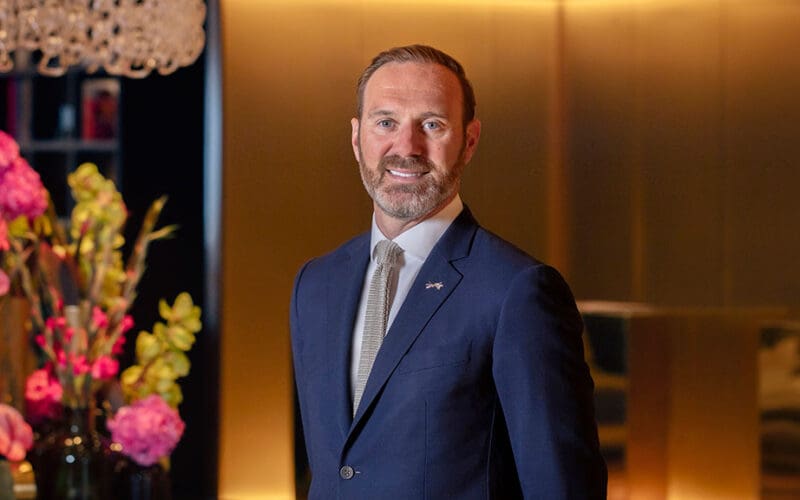
Most hoteliers can name the moment the industry got its hooks in. For Christian Wildhaber it happened in a darkened room in Vevey, in front of a projector, watching film shot by men who had been somewhere he had not.
“My grandfather, father and uncle all travelled extensively for work, and I was fascinated by the stories they brought back,” he says. “As a child, I would watch the old 8mm and 16mm films they had taken during their travels, showing places that seemed incredibly far away and exotic at the time. Those images sparked my imagination and made me dream about seeing the world for myself.”
There is a neat circularity in that for a business travel readership. An earlier generation of corporate travellers, flying out of Switzerland on business in an age when a trip abroad still merited a camera, produced the man who now runs one of the hotels their successors check into. Wildhaber took over as general manager of Mandarin Oriental, Geneva on 1 September 2026, returning to Switzerland after a year leading Mandarin Oriental, Jakarta.
The address he inherits carries some weight. The 178 room hotel sits on Quai Turrettini, on the right bank of the Rhone in the heart of the city, in a building that opened on 14 July 1950 as the Hotel du Rhone, the first luxury hotel built in Europe after the Second World War. Its inauguration coincided with the arrival of the United Nations in Geneva, and the guest list has followed the diplomatic calendar ever since. Mandarin Oriental took the property on in 2000.
The apprentice from Vevey
Wildhaber’s route into the industry was the Swiss one, learned rather than lectured.
“Originally from Vevey, Switzerland, I completed my apprenticeship education in Switzerland, a country renowned for its tradition of excellence in hotel management,” he says. “Fluent in French, English and German, I have been fortunate to build an international career that has provided valuable exposure to a wide range of cultures, business environments and guest expectations.”
That career has been unusually well travelled, even by the standards of a trade that expects its managers to move. “My professional journey has taken me to destinations including the United Arab Emirates, Hong Kong, Sydney, Morocco, Indonesia and China, each contributing to my understanding of luxury hospitality and service excellence,” he says.
Hospitality, he says, was the industry that let him keep the promise he had made himself in front of the projector. “It combines travel, culture, people and business. It offered the opportunity to meet individuals from every corner of the world while constantly learning from different perspectives and experiences.” Nearly thirty years on, he reports no change in the symptoms. “I still enjoy discovering new destinations, understanding different cultures and building connections with people from all walks of life.”
Openings, transformations and Jakarta
The line on his CV that explains why he was handed Geneva is the one before Jakarta. “Prior to Jakarta, I served as General Manager of Mandarin Oriental Palace, Luzern, where I led the transformation, opening and launch of the property,” he says. Opening a hotel is a different discipline from running one, and doing it on a Swiss lakefront, to Mandarin Oriental standards, with a heritage building involved, is a particular kind of examination. He passed it, then went to Indonesia in August 2025, then came home.
“With nearly three decades of experience in luxury hospitality, I am delighted to return to Mandarin Oriental, Geneva after leading Mandarin Oriental, Jakarta,” he says. On his appointment he was more specific about what drew him back. “International Geneva brings together people, cultures and ideas from around the world, and I look forward to working alongside our colleagues to uphold the hotel’s legacy of excellence and create exceptional experiences for our guests.”
For anyone who books travel into Geneva, that phrase, international Geneva, is the whole commercial story of the city. The United Nations agencies, the World Trade Organization, the banks, the commodity traders and the Palexpo exhibition calendar generate a demand pattern that is stubbornly corporate and stubbornly seasonal, and the hotels that serve it live or die on how well they read it.
The discipline of not chasing everything
Ask Wildhaber how he squares emerging trends against guests who still want the old certainties and he gives the answer of a man who has watched a few fashions come and go.
“Today’s guests are more informed, connected and discerning than ever before. They seek personalised experiences, authentic local connections, seamless technology and increasingly responsible business practices,” he says. “At the same time, they continue to value what has always defined true luxury: exceptional service delivered with warmth, sincerity and genuine care.”
The filter he applies is a commercial one rather than a fashionable one. “We do not adopt trends simply because they are fashionable. Instead, we focus on identifying innovations that genuinely enhance the guest experience while remaining consistent with our values and brand promise.”
On technology he draws the line that frequent travellers, worn down by app only service and self check in that checks nobody in, will be glad to hear. “Technology can make the experience more seamless and personalised, but it should always complement, rather than replace, the human connection that remains at the heart of hospitality.”
It is a position that sits comfortably with the wider Swiss argument about what luxury is for, and with the national tourist board’s decision to sell the country on silent luxury rather than spectacle. In a city where the client meeting is the reason for the trip, the hotel that removes friction without removing people tends to win the repeat booking.
The lesson that arrived late
Invited to audit his own career, Wildhaber does not reach for a false modesty. He reaches for something more useful.
“Looking back, one thing I would have done differently earlier in my career is to spend more time ensuring that everyone was progressing together on the journey,” he says. “When you are young, ambitious and full of energy, it is natural to focus on moving quickly, achieving goals and pursuing the next challenge. With experience, I learned that leadership is not about how fast one individual can move. It is about creating an environment where people can succeed, develop and grow together.”
The second admission is rarer still in an industry that treats relentless improvement as a virtue. “I have always been passionate about continuous improvement and striving for higher standards, which remains important. However, I have learned that acknowledging success along the way is equally valuable. People achieve their best when they feel recognised, supported and appreciated.”
That is not sentiment. It is recruitment policy. Mandarin Oriental topped the global luxury hotel rankings for a third consecutive year even as the sector was warned of a talent crisis, and every luxury operator in Europe is now competing for the same shrinking pool of people who can deliver the standards the brochure promises.
Wildhaber measures himself accordingly. “One of the greatest satisfactions I get as a leader is helping people achieve things they did not initially believe they were capable of accomplishing,” he says. “I believe that the true measure of leadership is not how long someone works with you, but what they learn, how they grow and where they go afterwards.” The corollary, which he states plainly, is the bit that matters to the guest. “Exceptional guest experiences are created by exceptional teams, and my role is to help colleagues reach their full potential.”
Loved, not just rated
His ambition for the hotel is stated without hedging. “My vision is to further strengthen Mandarin Oriental, Geneva as one of Europe’s leading luxury destinations and the preferred address for both international and local guests,” he says.
The route there is unglamorous and specific. “This involves continuously enhancing the guest experience, investing in our colleagues, embracing innovation where it adds value and deepening our connection with Geneva and the surrounding community. We want every guest interaction to feel personalised, memorable and distinctly Mandarin Oriental.”
Some of that connection is already on the plate. The hotel houses Ottolenghi’s first restaurant outside the UK alongside the Japanese room SACHI, which has given the property a dining proposition that pulls in Genevans as well as guests, a useful thing in a city where the expense account dinner is a competitive sport.
The group context has shifted too. Mandarin Oriental is being taken private by Jardine Matheson in a £3.1bn deal, a change of ownership structure that gives its general managers a longer runway than a quarterly reporting cycle usually allows. Wildhaber’s stated ambition suits that timescale. “Ultimately, our ambition is not simply to be recognised as a leading hotel, but to be genuinely loved by our guests, colleagues and the local community.”
Advice from the far side of thirty years
For those starting out, his counsel is refreshingly free of grand strategy.
“First and foremost, do not be afraid to ask questions. No one expects you to know everything at the beginning of your career, and curiosity is one of the most valuable qualities you can have,” he says. “Secondly, do not be afraid to make mistakes. Some of the most important lessons come from getting things wrong and learning how to improve.”
Then the part most young managers get wrong. “Too often, people focus on doing things they already know they can do. Real growth comes from taking on challenges that feel unfamiliar or even uncomfortable,” he says. “Volunteer for projects, explore different departments and embrace experiences that stretch your capabilities. The skills that will shape your future are often the ones you do not yet possess.”
And the closing argument, from a man who has spent thirty years finding out whether the films were telling the truth.
“Luxury hospitality continues to evolve, but one thing remains constant: people will always remember how you made them feel. Creating genuine connections, inspiring colleagues and delivering exceptional experiences are what make this industry so rewarding.”
On the evidence of what Quai Turrettini has seen since 1950, that is a fair description of the job he has taken on.
Fact file: Mandarin Oriental, Geneva
Where: Quai Turrettini 1, 1201 Geneva, on the right bank of the Rhone, roughly nine minutes on foot from Geneva Cornavin station and a short walk from the banking district and the old town
Rooms: 178 rooms and suites, with garden or river views
History: Opened on 14 July 1950 as the Hotel du Rhone, designed by the Geneva architect Marc J. Saugey and billed as the first luxury hotel built in Europe after the Second World War. Its inauguration coincided with the arrival of the United Nations in the city. It became a Mandarin Oriental property in 2000
Eating and drinking: Ottolenghi, the Ottolenghi group’s first restaurant outside the UK, plus SACHI and Omakase by SACHI for Japanese dining, and MO Bar for cocktails and all day light fare
Wellness: Spa treatments by Ambassade Biologique Recherche, a fitness centre and La Barbiere de Paris for grooming
Meetings: Seven event spaces including the Hodler Theatre, Calvin, Dalcroze, Dunant, Voltaire, La Table and the Foyer, configurable from boardroom to theatre style
Sustainability: Certified Swisstainable Level III, the programme’s leading tier
Getting there: Geneva Airport is around 5 to 7km away, typically 15 to 20 minutes by road depending on traffic, with direct flights from airports across the UK. Palexpo sits beside the airport, and the Palais des Nations is about ten minutes by car