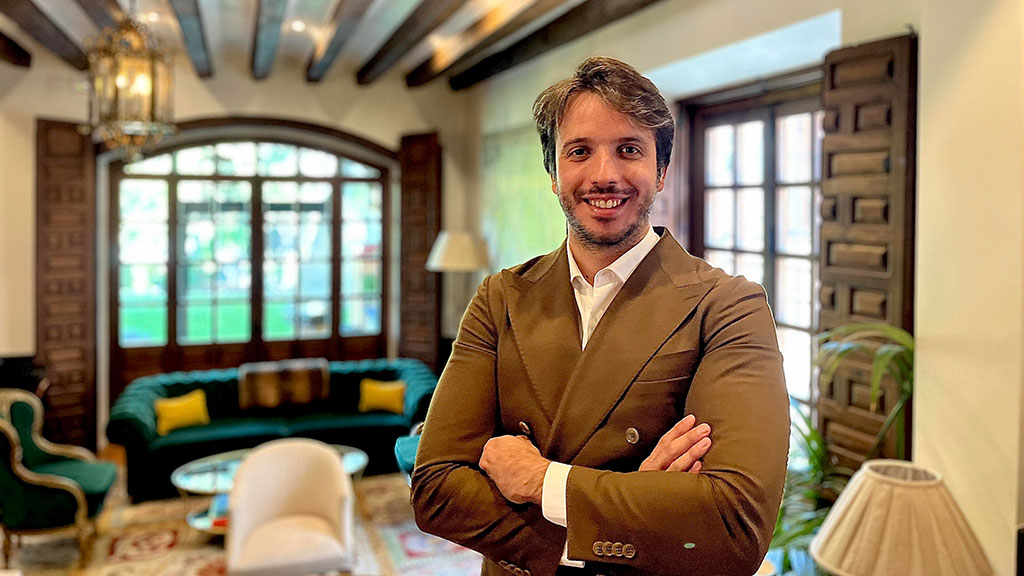
Most hotel careers move in one direction, outwards. You leave the small town, you join the big group, you collect the cities, and if you are good you eventually get handed something large and shiny with a lobby that echoes. Juan Vidal did all of that, and then he did the unfashionable thing. He went home.
Home is Ávila, the walled Castilian city an hour or so north west of Madrid, where the granite ramparts run for two and a half kilometres and the whole medieval centre, along with its churches beyond the walls, has been inscribed on the UNESCO World Heritage list since 1985. Vidal left at 17 to study law. He returned as general manager of La Casa del Presidente, a ten-bedroom hotel inside those walls that was, until fairly recently, the family home of Adolfo Suárez, the first president of democratic Spain.
It is a job with an unusual weight to it, and Vidal is refreshingly unsentimental about how he arrived at it.
The accountant’s apprentice
The first thing to understand about Vidal is that hospitality was never a career choice so much as a background hum. “My passion for hospitality has always been with me as I practically grew up in a hotel,” he says. “My mother has always worked in the industry as hotel manager, and I’ve been very close to her. From a young age, I was always interested in how it works, and she always wanted to teach me.”
Then comes the detail that tells you everything about the kind of manager he became. “When I was just eight years old, I remember sitting with her to review the accounting records and budgets. She would recite them to me, and I would double-check them.”
Eight years old, auditing his mother’s ledgers. It is a charming image, and also a clue. For all the talk of atmosphere and feeling that surrounds boutique hotels, Vidal is a numbers man who happens to be very good at warmth, rather than the other way around.
The formal route took a detour first. He went to study law, a sensible Spanish choice for a bright teenager with no obvious vocation, and it did not take. What did take was a summer job. “It wasn’t until I spent my first summer in England at 19, working at a luxury hotel, that I realised my passion for hospitality and guest service,” he says. “That’s why the following year I decided to study tourism with the clear goal of becoming a hotel manager.”
There is something pleasing, for a British magazine at least, about the fact that a Spanish hotelier’s road to Damascus moment happened somewhere in England during a student summer. He does not name the property, and I suspect the specifics matter less than the shock of recognition.
The association years
What followed was smarter than the usual graduate scramble. Before finishing his degree, Vidal secured an internship at the Madrid Hotel Association, the trade body representing the capital’s hoteliers, and stayed two years.
“I met leading industry professionals and expanded my network, as well as training in hotel marketing,” he says. It is a route very few people take deliberately, and it is worth pausing on. Most young hoteliers spend their first two years learning one property from the inside. Vidal spent his learning an entire city’s hotel market from above, sitting in rooms with the people running it. By the time he moved into operations he already knew the terrain and, crucially, the operators.
Madrid was a useful city in which to acquire that map. The Spanish capital has spent the past few years climbing the rankings of European corporate destinations, and it has become a fixture in the data-led lists of where business travellers are actually going. Vidal was learning its hotel economy just as that curve began to steepen.
A decade in the Hyatt machine
Then he jumped. “After two years there, I decided to take the plunge into the world of hotel operations with Hyatt, holding both operational and middle management positions.”
He stayed roughly a decade, and he talks about the group with the particular respect of someone who learned their trade inside a system rather than despite one. “Hyatt has been the company I’ve been with for practically my entire career and from which I’ve learned a lot about how to work well, with high quality standards, protocols and follow-ups for practically all processes.”
Protocols and follow-ups. Not the most romantic phrase in hospitality, but ask anyone who has tried to run a small independent property without them and they will tell you it is the difference between a hotel and an expensive guesthouse. The value of a big-group apprenticeship is not the brand on the door, it is the muscle memory: the discipline of checking, recording, closing the loop. Vidal took that with him.
What he did not take was the trajectory. Ten years in, with the corporate ladder in front of him, an offer came from home. “An amazing opportunity arose to return to my hometown and to take the reins of a historic ten-bedroom property called La Casa del Presidente.”
Ten bedrooms. After a decade in international hotel operations in Madrid. On paper it looks like a step sideways at best. In practice it is one of the more interesting bets in Spanish hospitality right now.
The house that Suárez built
The property itself is the reason. Adolfo Suárez built the house in the 1970s and used it as a family retreat for two decades, through the years in which Spain dismantled a dictatorship and assembled a democracy. Rooms in the hotel that occupies it now carry the names of the values associated with him: libertad, diálogo, paz, coraje. Freedom, dialogue, peace, courage. Reception sits in what was the president’s office. The library where conversations of some consequence took place is still there.
Handled badly, this could be museum-piece hospitality, all velvet ropes and reverence. Handled well, it becomes something rarer: a hotel with an actual moral centre. Vidal is clearly aiming at the second, and he connects it directly to how he manages.
“I love the world of quiet luxury, where there’s no stridency,” he says. “That’s why I try to base every decision I make on certain values, such as harmony, courage, freedom, serenity and justice. Interestingly, several of these values are represented by our hotel’s main character, Spain’s first democratic president, Adolfo Suárez, whose home this was, which is why I feel so comfortable in a project whose values I share.”
It is not often that a general manager can point at the walls and say, those are my management principles, and have it be literally true.
The house has since acquired the trappings that quiet luxury demands without much fuss. There is a garden with a swimming pool, one of very few inside the walls of the old city. There are ten rooms across three categories, deluxe, junior suite and suite, the largest running to 40 square metres with a private terrace. The hotel has joined Small Luxury Hotels of the World and now appears in the Michelin Guide’s hotel selection. For a corporate traveller, the practical appeal is a walled Castilian city under 90 minutes from Madrid by train, with a five-star bolthole that can be taken over in its entirety by a small board or an executive offsite. The thousand-delegate seminar is not the point here. The eight-person strategy session very much is.
Quiet luxury, and what it actually means
Vidal returns to the phrase repeatedly, and he uses it more precisely than most.
“In my opinion, I see emerging trends as an opportunity,” he says. “Hotels are increasingly trying to focus on the guest experience. This means we have to be closely aligned with social trends, while also keeping in mind that we’re a luxury hotel and that there are certain services and preferences our clients prefer that we can’t afford to miss. What I’m seeing more and more lately is a trend toward quiet luxury, where less is more. Something I wholeheartedly agree with.”
The balance he describes, chasing trends without abandoning the non-negotiables, is the central operational problem of small luxury hotels. Ten rooms give you no margin for error and no economies of scale. Every guest is a meaningful percentage of your occupancy. Get the service standards wrong and there is nowhere to hide.
It also happens to sit neatly inside a broader shift that this magazine has been tracking for some time, the migration of high-spending travellers away from saturated headline destinations towards places where the money goes further and the crowds do not follow, a pattern we examined in our look at the new geography of quiet affluence. Ávila, a UNESCO city of around 60,000 people with a fraction of Toledo or Segovia’s day-tripper traffic, is close to a textbook example.
The restaurant is the strategy
If quiet luxury is the tone, gastronomy is the plan. Vidal is unambiguous about it.
“At La Casa del Presidente, we are working to become a benchmark in high-quality hospitality paired with exceptional dining, an experience that, in many cases, becomes the reason for the journey itself,” he says. “Our goal is to be the kind of hotel where the hotel is the destination, placing special emphasis on gastronomy as the core of the experience through our newly opened Caleña restaurant, recently awarded its first Repsol Sol.”
Caleña is the sharp end of the strategy, and it has moved fast. The kitchen is led by Diego Sanz, a chef born in 2000 who has already passed through Zuberoa and Copenhagen’s Noma, cooking a tasting menu built on Castilian tradition reinterpreted with contemporary technique and local producers. The Repsol Sol arrived roughly four months after opening, reportedly the quickest award of its kind, and Michelin Guide recognition followed.
That speed matters commercially. A ten-room hotel cannot fill itself on rooms revenue alone in a city that is not, yet, on the standard corporate circuit. A destination restaurant does two things at once: it gives the property a reason to be visited by people who are not staying, and it gives guests a reason to choose Ávila over another walled Spanish city. The model of gastronomy as the anchor of a small luxury property is well established elsewhere in Europe, as we found on a similar trail through the Luberon’s gastronomy and wellness circuit, and it is arguably the only viable route for a hotel of this scale.
Vidal frames the ambition in wider terms than covers and revenue. “In short, our hotel aims to be an integral part of the culture of the place where it is located and to transmit this culture to all who wish to experience it.”
No regrets, and one piece of advice
I asked him, as I ask everyone, what he would have done differently. His answer was the most emphatic of the conversation.
“Not at all. In the end, what makes us who we are today are both our successes and our mistakes. The only thing we should always strive for is to do things in good faith, no matter what.”
For a man who could reasonably wonder whether ten years of corporate progression should have led somewhere with more than ten bedrooms, that is either serenity or conviction, and having spoken to him I suspect it is the latter.
His advice to those starting out is similarly plain. “My advice for anyone starting out in the hotel industry, or any other industry, is to do what you love, to be passionate about it, because it’s the only way to have a stable job and, of course, a chance to advance. Another piece of advice is to listen to people with experience, as studying is important, but having experienced certain situations is even more important.”
It is not a novel sentiment. It is, though, one earned by a man who checked his mother’s budgets at eight, abandoned law after a summer in an English hotel, learned a capital city’s market from a trade association before he had a degree, spent a decade absorbing a global group’s operating discipline, and then took all of it back to a granite town of 60,000 people to run ten bedrooms in a dead president’s house.
Quiet luxury, indeed. The strategy is anything but quiet.
Fact file: La Casa Del Presidente
Where: Calle Los Telares, inside the medieval walls of Ávila, Castile and León, Spain
Rooms: Ten, across deluxe rooms from 23 square metres, junior suites from 25 square metres and suites at 40 square metres, several with private terraces or patios. Rooms are named after values associated with Adolfo Suárez
History: Built in the 1970s by Adolfo Suárez, Spain’s first president of the democratic era, and used as a family retreat for around two decades. Reception occupies the former presidential office
Dining: Caleña, led by chef Diego Sanz, holds a Repsol Sol and appears in the Michelin Guide. ÑaCa offers casual dining in the garden
Facilities: Centennial garden, outdoor pool, wellness facilities, EV charging
Affiliations: Small Luxury Hotels of the World
Getting there: Ávila is roughly 90 minutes from Madrid by rail and a little over an hour by road, making it viable for a Madrid-based executive team as a one-night offsite