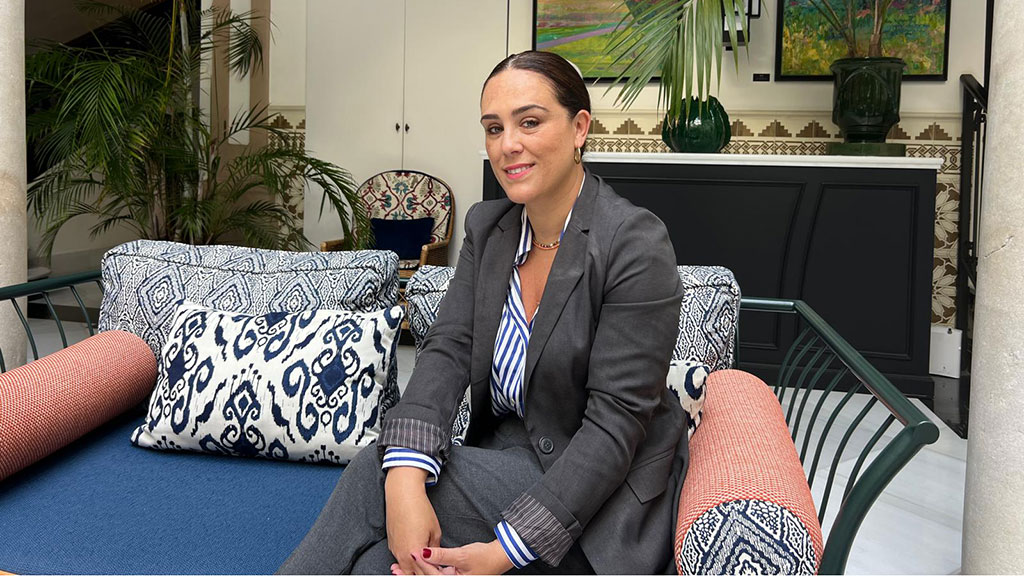
There is a particular discipline that comes with running a very small hotel, and Saray Castaño Ruiz has learned it the hard way. At Casa Palacio Don Ramón, the eighteenth-century palace on Calle Trajano that Kaizen Hoteles turned into a five-star Gran Lujo property in 2023, there are 26 rooms and two suites. Twenty-eight keys. On a full night that is 28 chances to delight somebody and 28 chances to be found out.
“A hotel is not just a place to sleep,” she tells me. “It is a complex machine which, if managed with passion and precision, can truly make a difference to people’s lives.” Coming from a general manager who spent 14 years inside large Spanish hotel chains before making the jump to boutique luxury, that is not a marketing line. It is a statement about scale, and about what happens to hospitality when you remove the buffer that a 300-room property gives you.
From the reception desk to the corner office
Castaño Ruiz’s career began, as many of the best hospitality careers do, with a placement on reception at a Spanish hotel chain. Over 16 years she moved steadily upward: front office manager, hotel manager, general manager, area manager, picking up responsibility for quality, human resources, revenue management, annual budgets and strategic analysis along the way.
“My focus has always been operational excellence,” she says, “prioritising attention to detail, guest satisfaction and the development of high-performing teams.”
What drew her in at the start was not the strategy, though. “From a young age I was fascinated by the idea of creating memorable experiences for people. I’ve always been observant and detail-oriented, and I found the hotel environment gave me the chance to channel that into something tangible: making people feel welcome, cared for and pleasantly surprised.”
The strategic side arrived later, and it arrived hard. “I entered the sector with a strong interest in service, but soon became captivated by the strategic side, team management, operations, revenue, and the daily challenges.” That progression, from host to operator to commercial thinker, is the arc that separates a good department head from a general manager, and it is worth noting that she made it inside the chain system before choosing to leave it.
Why she left the chains
The move to Kaizen Hoteles in 2023 was a deliberate change of gear. Kaizen is a homegrown Spanish company founded in 2016 by Marisa C. de Azcárate, and it specialises in a very particular kind of asset: historic buildings, small room counts, serious art on the walls. The group’s portfolio now runs to Casa Palacio Don Ramón in Seville, Casa Palacio María Luisa in Jerez de la Frontera and La Malvasía in El Rocío.
“After 14 years with larger hotel chains, I made the move to Kaizen, a homegrown company specialising in luxury boutique hotels, where I currently work as general manager of a five-star Grand Luxury property in the heart of Seville,” she says. “This transition has allowed me to apply and expand my expertise in a more exclusive setting, where service personalisation and quality are paramount.”
The property she inherited is not a soft posting. Don Ramón occupies a palacio a short walk from the Alameda de Hércules, restored with two internal courtyards, the Orange Tree Courtyard and the Lemons Courtyard, a rooftop terrace with a pool and a view across the old city, and El Limón, the hotel restaurant. Interiors are by Alejandra Pombo, and the art is drawn from de Azcárate’s own collection, which means Castaño Ruiz is effectively running a small museum with beds in it.
The engineering is quietly more impressive than the decoration. Behind the eighteenth-century facade sits geothermal energy, radiant flooring beneath the cobbles, full thermal insulation and soundproofing throughout, the sort of investment that does not photograph well but decides whether a guest sleeps through a Seville summer. For a business traveller, that combination of a historic centre address and a properly insulated room is the whole proposition.
The market has noticed. In 2024 the hotel was named World’s Leading New Boutique Hotel at the World Travel Awards, beating nominees from Japan, the United States, Mexico and Greece, and it has continued to collect regional and national titles since. It is the kind of recognition that raises expectations faster than it raises rates.
The revenue manager’s regret
Ask most general managers what they would do differently and you get a diplomatic non-answer. Castaño Ruiz is more specific, and more useful.
“Looking back, I might have devoted more time, earlier on, to formally specialising in revenue management,” she says. “It’s always been an interest area which I have self-taught and picked up on the job, but delving sooner into its technical and analytical aspects would have given me more tools to make strategic decisions.”
It is a revealing admission, and a timely one. Spanish hotel economics have shifted decisively toward rate rather than volume. According to Spain’s National Statistics Institute, average daily rate reached €122.30 in April 2026, up 4.9% year on year, with RevPAR up 5.5% to €81.70 while overnight stays grew only 1.1%. In other words, the growth is coming from pricing decisions, not from more bodies through the door. In a 28-key hotel, where a single room night can move the month, that skill is not a nice-to-have.
She is careful, though, not to present the discipline as a spreadsheet exercise. “I am comfortable working under pressure and passionate about optimising revenue through effective revenue management,” she says. “My main goal is to ensure every guest enjoys a unique experience while managing the hotel’s resources precisely to secure long-term profitability and sustainability.”
That final word matters. Profitability and sustainability are, in her framing, the same conversation.
Innovation, applied judiciously
Boutique luxury has a particular exposure to technology fashion. Do too little and you look dated; do too much and you have replaced the very thing guests are paying for. Castaño Ruiz’s answer is a phrase worth borrowing.
“My approach is to apply innovation judiciously,” she says. “Everything we implement must enhance the guest experience, not complicate or detract from it. For example, we’ve adopted contactless technology, but without losing the human touch our boutique luxury guests expect.
She keeps current through what she calls “constant active listening and observation”, a mixture of continuous learning, benchmarking and trade shows on one side, and direct feedback from guests and team on the other. “That’s where you truly see what works and what doesn’t.”
Then comes the line that ought to be pinned above a few more front desks. “I believe the key is knowing when to lead change and when to let the guest set the pace.”
She is also clear that trend-watching cuts both ways. Technology, sustainability, wellness and personalisation are the four headings she keeps under review, but the filter she applies to each of them is the same: does the guest in front of her actually want it? In a house this size the feedback loop is immediate, because the general manager is rarely more than a courtyard away from the person paying the bill. “I also place great value on direct feedback from our guests and my team,” she says. It is a governance model that larger properties spend fortunes trying to replicate through survey software.
For corporate travel buyers, that translates into something practical. Don Ramón is not trying to be a conference hotel. Its meeting capability sits in a multipurpose room fitted with screens, sound and high-speed connectivity, suited to a board offsite, a private negotiation or a small executive briefing rather than a 200-delegate plenary. That is a deliberate positioning, and it puts the property squarely in the segment we examined in our ranking of the best luxury hotels for business travel in 2026, where the buying decision turns on discretion and service density rather than square metres of ballroom.
A management style built on involvement
Small teams are unforgiving. There is nowhere to hide a weak hire and no depth chart to cover an absence. Castaño Ruiz’s approach is built accordingly.
“My management style is based on collaborative leadership, informed decision-making and the flexibility to adapt to daily challenges,” she says. “I like to involve my team in key decisions, as I believe motivation and commitment come when everyone feels an active part of the process.”
The counterweight is planning. “At the same time, I am very strategic and meticulous in planning, especially when it comes to revenue management and resource optimisation. I work calmly under pressure, prioritising clear communication and effective delegation.”
She describes the balancing act in terms any operator will recognise. “Balancing operational quality standards with openness to innovation is crucial in a boutique luxury hotel. I strive to be approachable, listen to my team’s needs and anticipate our guests’ expectations, enabling high levels of satisfaction and efficiency.”
It is worth saying that this is happening in one of Europe’s tightest hospitality labour markets. Seville’s tourism growth has outpaced its ability to staff it, and the competitive set is thickening: Ascott has been signing new European properties including in Seville, and IHG has been adding Spanish properties to its portfolio at a steady clip. Every new opening is a bid for the same head housekeeper.
Three words
Asked for her strategic goals, Castaño Ruiz does not deliver a mission statement. She delivers a list of three.
“My three priorities are: profitability, growth and adaptability. The company’s continued success depends on achieving these objectives, which in turn enables the pursuit of all other goals.”
The brevity is the point, and it aligns neatly with where Kaizen itself is heading. The group has launched byKaizen, a management arm intended to run luxury properties for third-party owners, with its first mandate the 18-room Hotel Felipe V on Calle Betis, across the river in Triana, due to open in 2026 and again designed by Alejandra Pombo. A group that was a collector of buildings is becoming an operator of them, and that shift requires exactly the general managers who can run a small asset with chain-grade commercial rigour.
There is a wider lesson here for independent operators watching the branded groups consolidate. The chains have distribution, loyalty currency and procurement scale. What the small independent has is the ability to decide something on a Tuesday and do it on a Wednesday, provided the person running the building understands the numbers well enough to be trusted with the decision. Kaizen’s bet, in effect, is that the second advantage is worth more in the luxury segment than the first. Castaño Ruiz is the proof of concept.
The demand backdrop is helpful. Seville airport traffic rose more than 11% year on year in April 2026, and the city has been steadily adding the long-haul and network connections that turn a leisure destination into a viable business one. A five-star house of 28 keys in the historic centre is well placed for the consultant, the deal team and the visiting executive who wants somewhere that does not feel like an airport hotel.
Advice for the next generation
For anyone starting out, her counsel is unfashionably blunt about doing the work.
“I’d tell them to come in with humility, curiosity and the right attitude. This is an industry where practical experience is invaluable, no task is too small, and everything you learn, from reception to reservations to housekeeping, will help you if you aspire to management.”
Then the part that reflects her own stated regret. “Don’t neglect the analytical side. Nowadays it’s not enough to be a good host; you must be able to interpret data, understand the business and adapt quickly to change. If you combine a service mindset with strategic thinking, you’ll go far.”
There is a symmetry to that. A career that began on a reception desk and ran through front office, operations and area management has arrived at a conclusion that sounds simple and is not: hospitality is empathy, anticipation and a passion for detail, and it is also a P&L. The general managers who thrive over the next decade will be the ones who refuse to choose between the two.
Twenty-eight keys, no hiding place. On the evidence, Castaño Ruiz would not want one.
The property: Casa Palacio Don Ramón at a glance
Location: Calle Trajano 2, Seville 41002, in the historic centre near the Alameda de Hércules.
Category: Five-star Gran Lujo (GL), operated by Kaizen Hoteles.
Opened: 2023, in a restored eighteenth-century palacio.
Rooms: 26 rooms plus two suites, the Sevilla and the Don Ramón.
Design: Interiors by Alejandra Pombo, with hand-painted wallpapers and local artisan craftsmanship drawing on Arab, Mozarabic and New World influences. Art from the owner’s private collection is displayed throughout.
Facilities: El Limón restaurant, two interior courtyards, rooftop terrace with pool, Kaizen bar, and a multipurpose room with screens, sound and high-speed connectivity for small meetings and remote working.
Sustainability: Geothermal energy, radiant flooring, thermal insulation and soundproofing installed during the restoration.
Recognition: World’s Leading New Boutique Hotel, World Travel Awards 2024, plus subsequent regional and national boutique hotel titles.