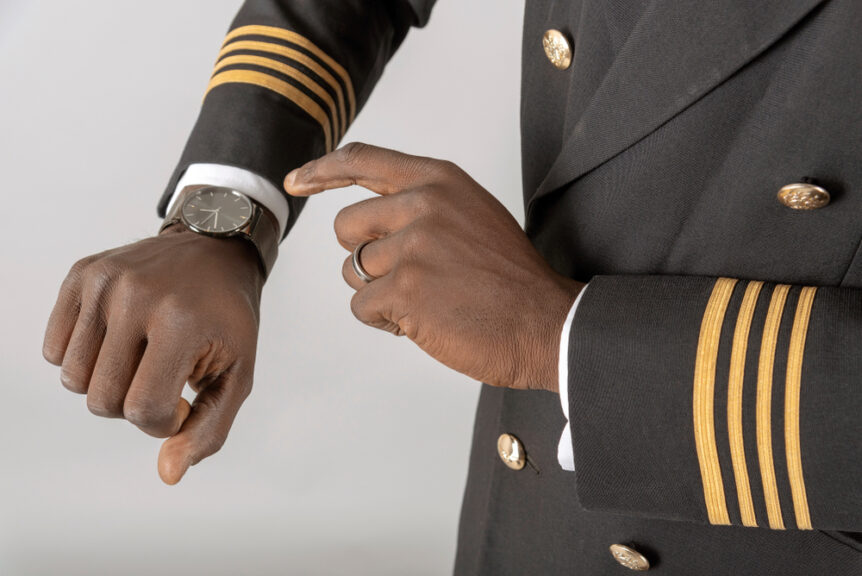
Most of us have walked through an airport and seen it: a pilot striding through the terminal, uniform immaculate, sleeves marked with crisp stripes.
It’s a familiar image almost cinematic yet for all the times we’ve watched those stripes pass by, very few travellers ever stop to wonder what they mean?
They’re so woven into the visual language of flying that they almost disappear into the background and yet, as it turns out, those stripes are not decorative at all. They are a code, a quiet and instantly readable hierarchy worn on the sleeve.
According to David Davidoff – Director of Business Development at Jetseam, a US-based company producing high-quality uniforms for airline pilots, the confusion is extremely common. People see the uniform constantly, he says, but rarely understand the significance of the details. The stripes are, in fact, a clear indicator of rank and experience within the cockpit a visual shorthand for who is responsible for what at 38,000 feet.
The system is simple: fewer stripes indicate a pilot earlier in their commercial career, mid‑level stripes belong to experienced first officers, and four stripes mark the captain, the pilot in command of the aircraft. Airlines may vary slightly in styling, but the meaning is broadly consistent across the industry, a blend of training level, flight hours and command responsibility.
What makes this so fascinating is not that the information is hidden – it isn’t. It’s right there, in plain sight, every time you board a flight. It’s that most of us simply never think to ask. We glide past pilots at the gate, nod politely as we step onto the aircraft, and settle into our seats without ever realising that the person greeting us may be the captain, the senior first officer, or a junior pilot building hours toward command.
Once you know you can’t unsee it. The stripes become a small but revealing detail, a glimpse into the structure and discipline behind commercial aviation. They tell you who is leading the flight, who is supporting and how the cockpit team fits together. It’s a reminder that flying is not just technology and turbulence forecasts, but a human craft built on experience, training and trust.
So next time you’re boarding, take a moment. Look at the sleeves. Those stripes aren’t just part of the uniform they are the story of the journey ahead, written in four simple lines.